

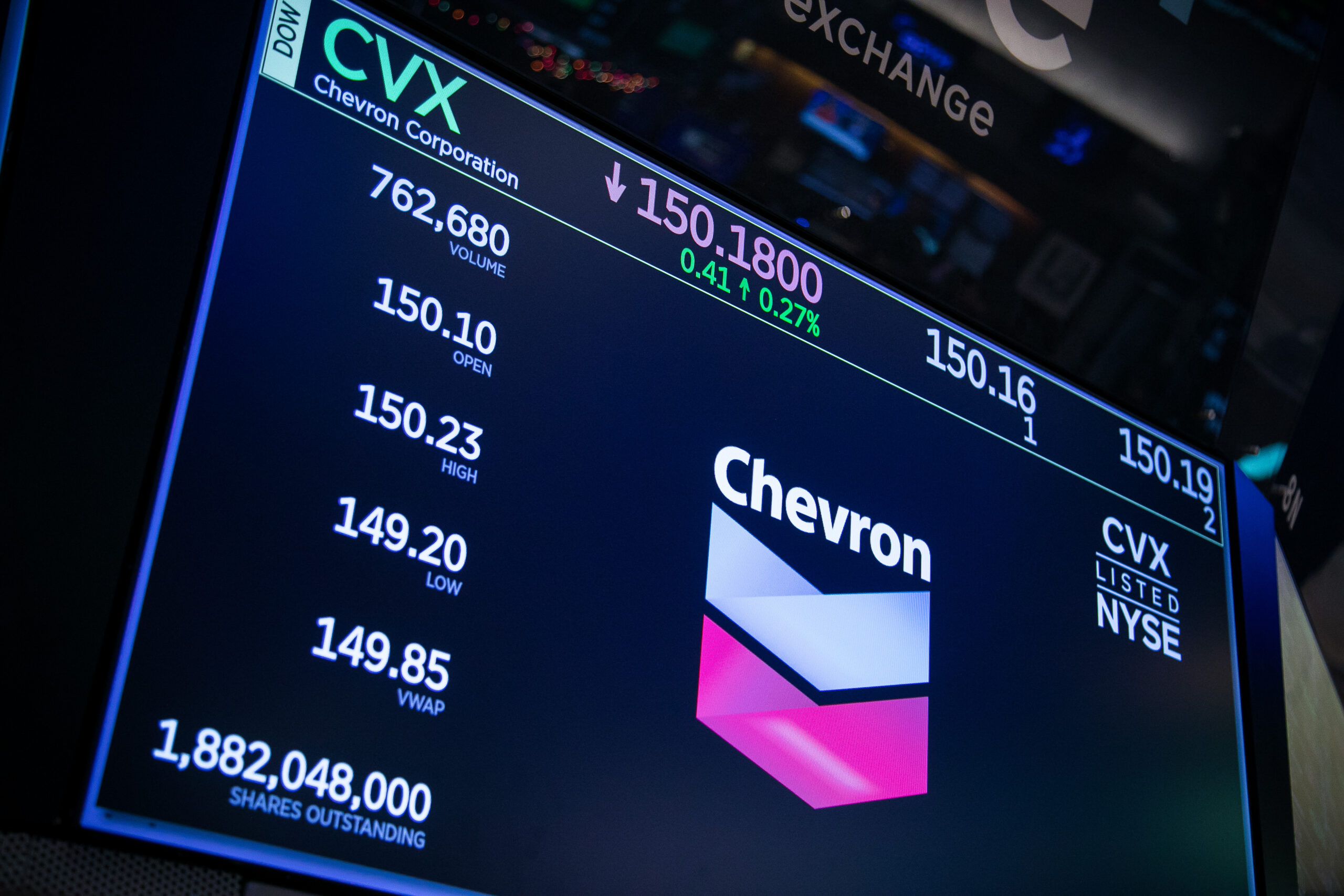
While ExxonMobil disclosed a clear 6% hit to its global first-quarter 2026 production from the Iran conflict—centered heavily on damaged Qatar LNG infrastructure—Chevron’s exposure appears materially lower and more temporary. Chevron has not issued a comparable company-specific production-loss figure, and analysts (including HSBC) highlight its lighter Middle East footprint relative to Exxon. The net result: both majors are seeing a revenue tailwind from sharply higher oil and LNG prices, but Chevron looks positioned for less volume pain and potentially faster normalization in Q1/Q2 reporting.
Production Exposure: Chevron ~4.5% vs. Exxon’s 6%
Chevron: Pre-conflict Middle East output was approximately 165,000 barrels of oil equivalent per day (boe/d), or roughly 4.5% of the company’s total ~3.7 million boe/d production in 2025. Key assets include the Leviathan gas field offshore Israel (operated by Chevron) and interests in the Partitioned Neutral Zone (PNZ) between Saudi Arabia and Kuwait.
ExxonMobil: 6% of worldwide output (~282,000 boe/d out of ~4.7 million boe/d), with roughly half tied directly to two damaged LNG trains in Qatar where Exxon holds 30–34% working interests. Those trains represent ~17% of Qatar’s total LNG capacity and could be offline for 3–5 years.
Chevron’s exposure is more diversified and less concentrated in high-value, long-lead-time LNG assets. No reports indicate physical damage to Chevron-operated facilities comparable to the missile strikes on Qatar’s Ras Laffan complex.
Asset-by-Asset Breakdown of Disruptions
Israel (Leviathan Gas Field): Chevron was ordered by Israeli authorities to shut production in early March 2026 as a precautionary measure amid heightened security risks. The ~33-day outage affected Israel’s largest gas project and exports to Egypt/Jordan. Production resumed in early April 2026 with no reported structural damage; the company has even advanced expansion plans. Impact on Chevron’s quarterly volumes was modest and short-lived.
Partitioned Neutral Zone (Saudi-Kuwait): Regional Gulf shut-ins (7.5–9.1 million bpd across Iraq, Saudi, Kuwait, UAE, Qatar, etc.) and Strait of Hormuz logistics issues likely affected PNZ crude flows, but Chevron has not flagged material or long-term downtime. Broader precautionary halts occurred, but no specific Chevron damage announcements.
Qatar and Other Gulf: Unlike Exxon (and to a lesser extent Shell on the Pearl GTL facility), Chevron has no major upstream LNG or oil production stakes in the directly damaged Qatar trains. Its Mesaieed presence is primarily through the Chevron Phillips Chemical joint venture (petrochemicals), not core hydrocarbon output.
In contrast, Exxon’s Qatar hit alone accounted for ~3 percentage points of its 6% global shortfall and carries multi-year repair timelines.
Broader Regional Context (Same for Both)The Iran war triggered unprecedented Gulf shut-ins (up to 9.1 million bpd in April per EIA-linked reports) plus near-total paralysis of Hormuz shipping. Both companies face indirect effects: full normalization of production and tanker movements could take weeks to months, even after any ceasefire, with some infrastructure repairs stretching years. Chevron CEO Mike Wirth has repeatedly noted that recovery “will take time” and that markets have not fully priced the physical supply tightness.
The Price Offset: Higher Commodities Benefit Both, but Chevron May Capture More Net
Brent crude has roughly doubled from pre-war levels (~$65 to $110+/bbl). LNG prices have also spiked. Industry math shows every $10/bbl Brent increase adds billions in upstream earnings across large portfolios. Chevron’s smaller direct volume loss means a higher percentage of its output benefits from the price surge. Analysts have raised Chevron’s Q1 2026 EPS estimates by an average ~40% since the conflict began.
Q1/Q2 Implications for Investors
Q1 2026: Exxon’s 6% hit is fully reflected. Chevron’s primary disruption (Leviathan) covered only ~1 month of the quarter → smaller sequential impact.
Q2 2026: Leviathan is already back online. Any lingering PNZ or shipping issues will be partially offset by global optimization. Exxon’s Qatar LNG repairs remain a longer-term drag.
Watch for: Chevron’s upcoming earnings (late April/early May) for exact Q1 volumes, force majeure details, and guidance on PNZ or Israel ramp-up. Also monitor free-cash-flow generation and any acceleration of non-ME projects (Guyana, Permian).
Bottom Line: Chevron’s Mideast disruptions are real but meaningfully smaller and shorter-duration than Exxon’s—roughly 4.5% exposure dominated by a temporary Israel gas shutdown versus Exxon’s 6% with multi-year Qatar LNG damage. Both companies are net beneficiaries of the commodity-price windfall, but Chevron’s lighter regional concentration and quicker asset recovery give it a relative edge in navigating the volatility. Diversification and U.S.-heavy production remain key advantages for CVX in this environment.
Energy News Beat – Independent energy market analysis. All data as of April 8, 2026.
Appendix:
Sources CNBC: Chevron CEO comments on Iran war pricing and recovery (March 23, 2026) – https://www.cnbc.com/2026/03/23/chevron-ceo-oil-price-iran-war-strait-hormuz.html
Reuters: Qatar LNG damage details and partner impacts (March 19–20, 2026) – https://www.reuters.com/business/energy/iran-attack-damage-wipes-out-17-qatars-lng-capacity-three-five-years-qatarenergy-2026-03-19/
Seeking Alpha / MSN: Chevron CEO on Middle East production recovery timelines (March 23–24, 2026)
Argus Media: Leviathan restart after 33-day shutdown (April 2026) – referenced in multiple outlets
Fortune / Houston Chronicle: Houston majors’ exposure overview (March 10–12, 2026) – https://fortune.com/2026/03/12/exxon-chevron-us-oil-gas-producers-refiners-all-time-high-stock-values-iran-war/
Yahoo Finance / OilPrice: Chevron Leviathan shutdown and broader Gulf impacts (March 2026)
HSBC analyst note: Lower Middle East exposure for Chevron vs. Exxon (March 20, 2026)
Data cross-referenced from EIA-linked reports on regional shut-ins and company disclosures.