

The Nasdaq 100 fell more than 6 percent on Thursday morning. Wall Street is pointing to both Democratic wins and chipmaker earnings. Here is what moved on the election and what did not, what Texas Governor-elect Gina Hinojosa can actually do, whether public pensions are really dumping AI stocks, and who ends up paying for the grid.
By Stuart Turley, host of the Energy News Beat podcast
Published Nov. 5, 2026 | Closing prices: Nov. 3 and Nov. 4, 2026 (Nasdaq.com, CNBC) | Nov. 5 index values are delayed intraday quotes and stock prices are real-time intraday quotes, taken 9:52 to 9:54 a.m. CT; they will change | Pension holdings: SEC Form 13F, as of Dec. 31, 2025 and June 30, 2026 | Not investment advice
If you own an index fund, you felt Thursday morning. The Nasdaq 100 was down more than 6 percent before lunch on the East Coast. Bloomberg’s markets wrap put it this way: a post-election slide in chipmakers “snowballed,” as investors bailed “on speculation the Democratic sweep in Congress will usher in a new era of regulation for the artificial-intelligence industry.” That is a real explanation. It is not the only one, and the timing matters.
Two days, two different selloffs
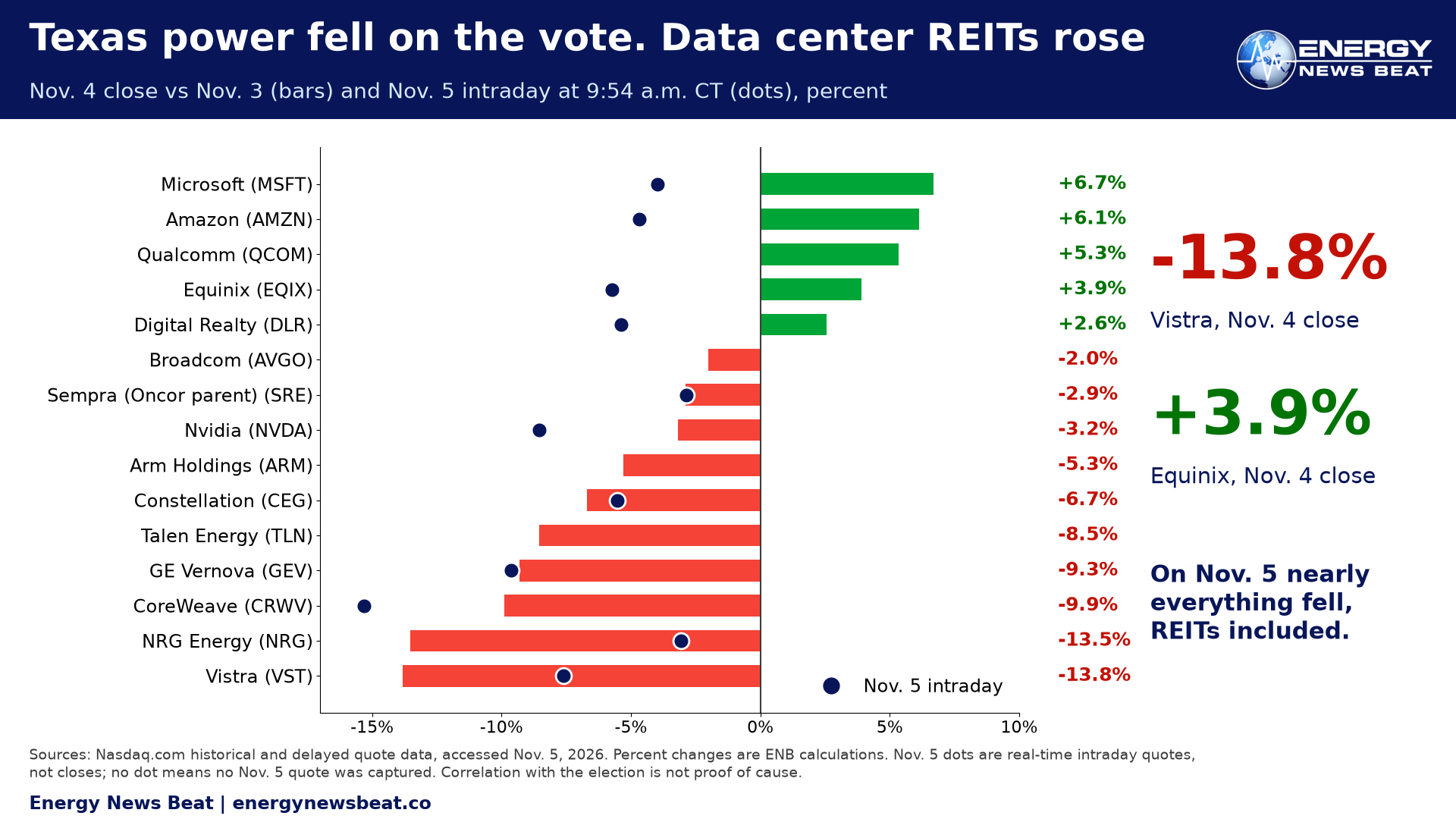
Start with Wednesday, Nov. 4, the first full trading day after the vote. The Nasdaq 100 closed up 0.91 percent (Nasdaq.com). The S&P 500 gained 1.58 percent and the Dow rose 3.03 percent, helped by an oil price drop (CNBC; AP). Under that calm surface, the election trade was violent. Vistra fell 13.8 percent, NRG 13.5 percent, Talen 8.5 percent and Constellation 6.7 percent (Nasdaq.com). The PHLX Semiconductor index fell 3.1 percent (Nasdaq.com). But data center landlords Equinix and Digital Realty rose 3.9 and 2.6 percent, and Microsoft and Amazon each gained more than 6 percent.
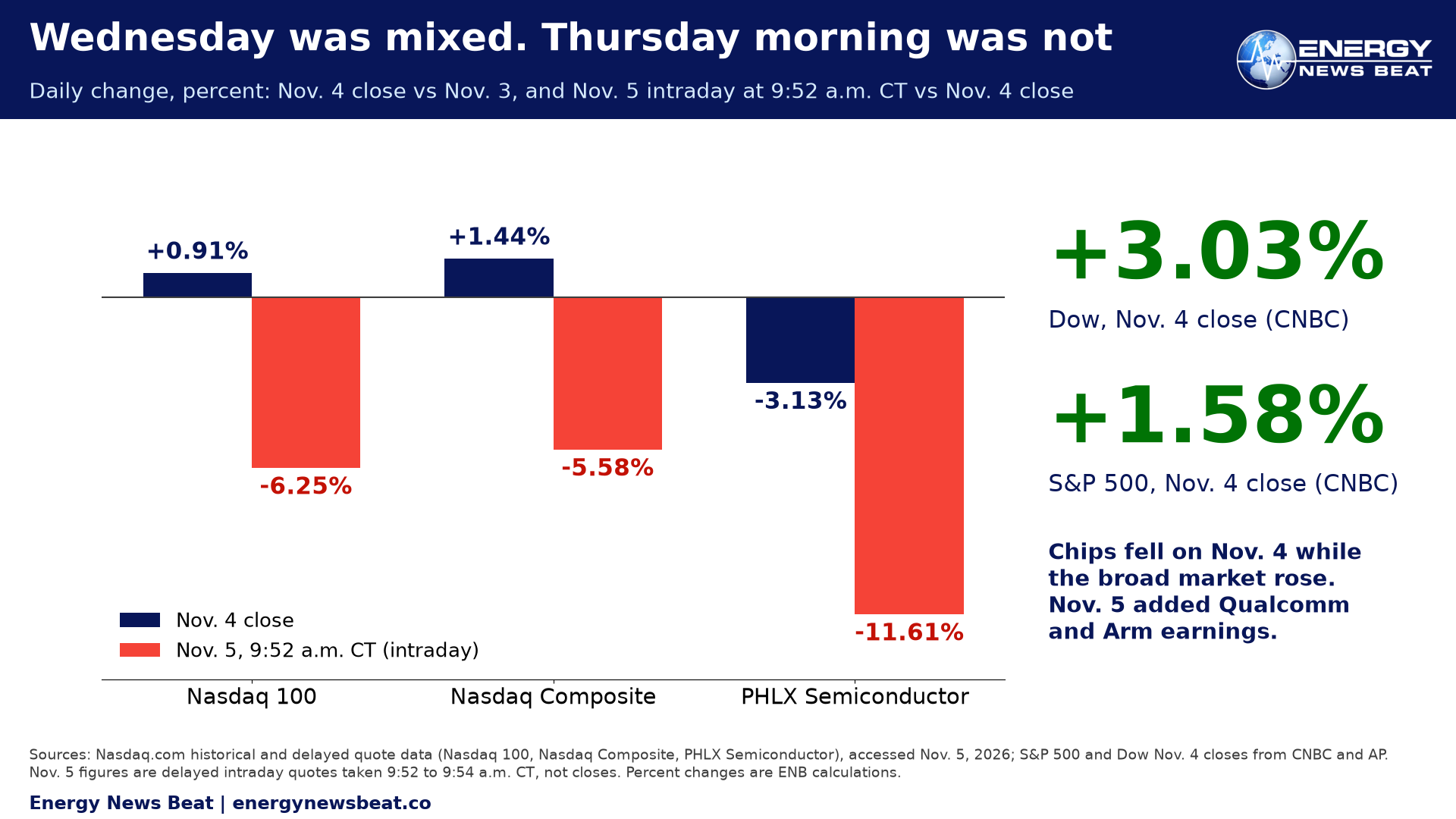
Thursday, Nov. 5, is the bigger drop, and it has a second engine. NBC News reported the selloff “was triggered by two lackluster earnings reports from major chipmakers, Qualcomm and Arm Holdings” (NBC). CNBC, by contrast, said Arm “delivered a strong earnings report” (CNBC). Qualcomm fell about 9 percent in early trading on its outlook (NBC), and Micron paused a Taiwan plant (StockAnalysis). At 9:52 a.m. CT, delayed quotes showed the Nasdaq 100 down 6.25 percent and the chip index down 11.6 percent (Nasdaq.com). Those are morning numbers, not closes.
So be honest about what moved on what. On Wednesday, the election clearly hit Texas power producers and the most speculative AI cloud names. It did not hit the data center REITs or the hyperscalers, which went up. On Thursday, earnings, chip news and worries about AI returns piled on top of election fears, and almost everything fell together, REITs included.
What analysts are actually saying
The notes we could read point to “slower and costlier,” not “stopped.” KeyBanc downgraded Vistra, citing its Texas exposure, two days before its Nov. 6 earnings (Investing.com). UBS put about 30 percent of 2028 data center capacity at risk (Investing.com), and Wells Fargo estimates Texas is about 27 percent of U.S. data center gigawatts (CNBC). UBS wrote that “data center pauses will slow the pace of buildout into 2028” (StockAnalysis). MRB Partners said, “The U.S. mid-term election results will add to headwinds for big tech and the data center buildout” (CNBC). Dan Ives of Yorkville Ives wrote in a note cited by Fortune that the buildout will now “happen at a more measured pace which is likely a good thing in the eyes of many investors” (Fortune). Bank of America flagged that Ohio Governor-elect Amy Acton’s power to appoint utility regulators could make the debate “more durable than a campaign-only issue” (Latitude Media).
What a Democratic governor can do in Texas
Hinojosa beat Gov. Greg Abbott 52.8 percent to 45.7 percent with about 99 percent of the expected vote counted; the race was called at 10:17 p.m. CT on Nov. 3 (AP call, via Movement Voter Project; Star-Telegram). She takes office Jan. 19 (Texas Tribune). Her promise is blunt: “When I am governor I will issue a moratorium — a ban — on all data center approvals until laws can be passed by the Legislature to protect Texans” (Texas Tribune). She told Politico in September, “We can have economic development and we can have protections for Texans. These things are not mutually exclusive” (as quoted by Texas Tribune).
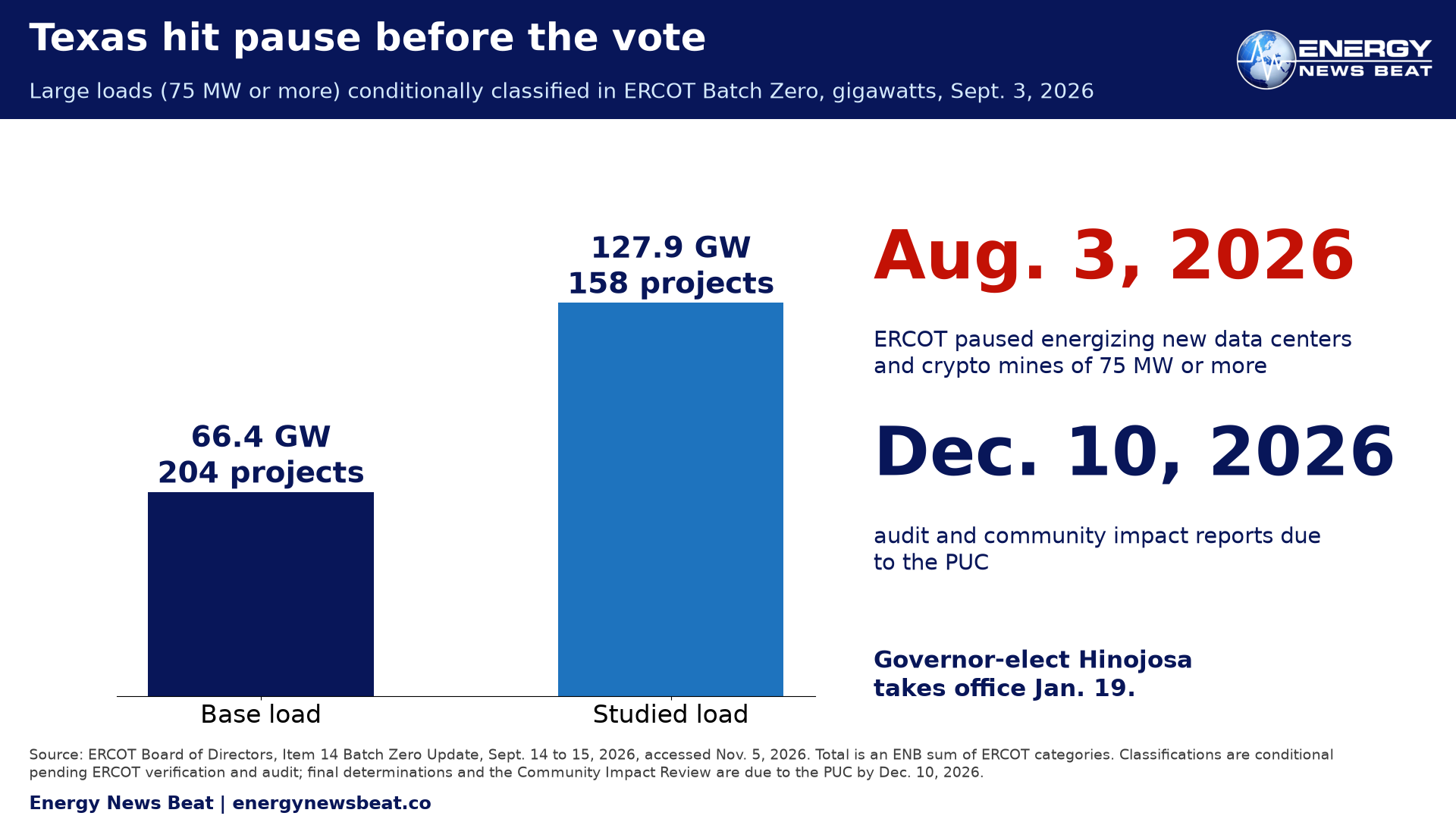
Here is the part markets may be underpricing: Abbott already hit the brakes, in four steps. On Aug. 3 he ordered the PUC and ERCOT to audit every data center in the interconnection process (Governor’s office), and ERCOT paused energizing new data centers and crypto mines of 75 megawatts or more the same day (ERCOT). On Sept. 14 he ordered the Water Development Board to enforce water-use reporting (Governor’s office). On Sept. 21 he ordered TCEQ to halt all permits sought by data centers until the audit is done (Governor’s office). On Oct. 21 TCEQ took its electronic permit filing system offline and expects it back in mid-November (TCEQ; Texas Tribune). ERCOT’s audit reports are due Dec. 10. Its transitional study, called Batch Zero, conditionally includes 362 large loads totaling about 192 to 194 gigawatts (ERCOT figures vary between slides). A new governor inherits a pause. She does not have to invent one.
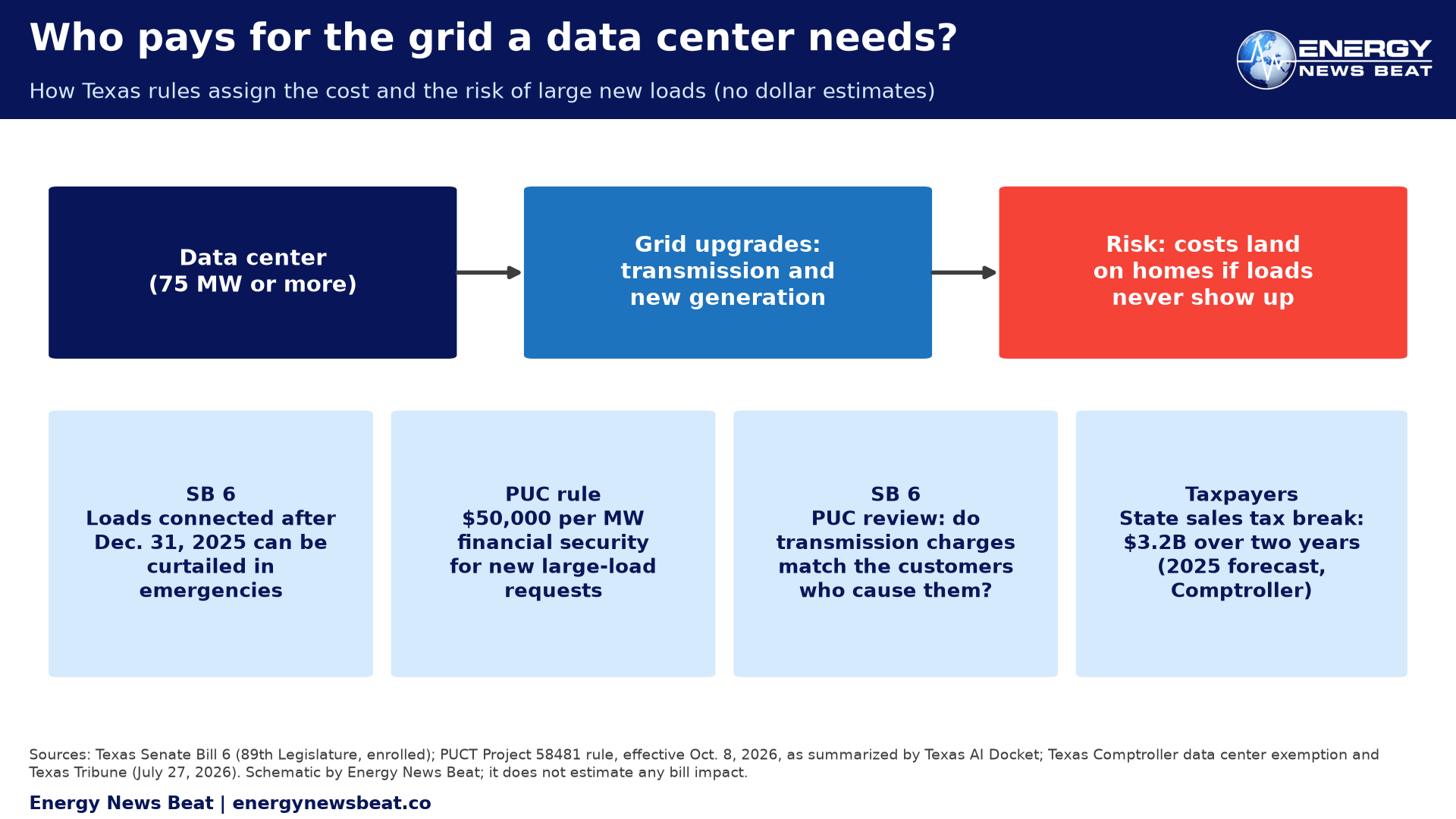
Her strongest tool is people. The governor appoints all five Public Utility Commission members, with Texas Senate consent, to staggered six-year terms (Utilities Code 12.051). Those commissioners will implement Senate Bill 6, the 2025 law that sets a 75 megawatt large-load threshold, makes new large loads connected after Dec. 31, 2025 curtailable during emergencies, and orders the PUC to review whether transmission costs are allocated to the customer classes that cause them. The PUC’s new rule requires $50,000 per megawatt in financial security for new large-load requests (PUC order); the Texas AI Docket reports it took effect Oct. 8 (Texas AI Docket).
Money is the other lever. Data centers get a state sales tax exemption on equipment and electricity (Comptroller). In 2025 the state forecast it would lose $3.2 billion over two years, and the Comptroller’s revenue estimator said the next estimate “will be significantly higher” (Texas Tribune). Repeal takes the Legislature, but Republican Sen. Joan Huffman has already promised a reform or repeal bill (Texas Tribune). The governor’s office also signs JETI property tax agreements (Comptroller). Water is the weakest lever: we found no statewide data center water law, and Abbott has relied on agency enforcement (Reuters; Governor’s office).
The blue-state playbook, and what stocks did
Texas is not alone. New York Gov. Kathy Hochul signed the nation’s first moratorium on new hyperscale data centers on July 14, saying data center development “threatens to hike up utility bills, deplete our natural resources” (New York governor). In victory speeches, Sen.-elect Sherrod Brown said, “I do not work for data centers,” and Illinois Gov. JB Pritzker said, “We enacted the toughest AI regulations in the country” (Tech Policy Press). Acton promised a conditional pause in Ohio, Keisha Lance Bottoms a statewide pause in Georgia (Fortune), and Wisconsin’s David Crowley a pause and a sales tax repeal (Latitude Media). Politico reports analysts see new moratoriums making projects costlier rather than halting them (Politico).
Correlation is not causation. The stocks that fell hardest on Wednesday were the ones most tied to selling Texas power into new load. The companies that own existing, already-connected data centers rose. A pause makes the capacity that already exists more valuable, and that is a reasonable reading of Wednesday. We cannot prove it.
Consumer and investor views
For investors, three questions matter more than the headlines. Does your fund own IPPs whose story depends on new Texas load? How much AI and chip concentration sits in your index fund? And can you hold through a slower buildout? Vistra reports Friday, Nov. 6; listen to what it says about Texas contracts.
The cost of saying no is the other side of that ledger. Energy News Beat friend and frequent podcast guest David Blackmon lays it out in Forbes today. BaRupOn LLC says it had a $250 million Permian Basin data center project with funding in place and closing weeks out, and that after Abbott’s freeze it moved the project to Wyoming. CEO Balaji Tammabattula estimates the lost campus at “three to four billion dollars on the data center build-out, not including the compute,” and says, “it’s not the same Texas I experienced three years ago” (Forbes). BaRupOn’s LAMP Texas campus in Liberty County plans more than $3 billion of investment on behind-the-meter gas power from Kinder Morgan: 60 megawatts this fall, 240 in 2027, up to 3 gigawatts. “We’re not even connected to the grid,” he told Blackmon. “Your bills are not going up because of us.” Blackmon warns the pause “could well become permanent Texas policy” under Hinojosa, sending billions and jobs to friendlier states. The politics behind the freeze were real: 57 percent opposed a data center in their community in an August poll, 60 percent of rural voters (Texas Politics Project).
Now the pension question. We could not confirm a post-election pension selloff, and we are not going to assert one. Public funds report U.S. stock holdings within 45 days after each quarter (SEC), so no filing yet shows trades made this week. What filings do show is earlier de-risking. CalPERS cut its Nvidia shares 39.7 percent and Microsoft 25.2 percent between Dec. 31, 2025 and June 30, 2026 (SEC). Its deputy chief investment officer, Anton Orlich, described trading “large concentrated exposure to those seven companies for exposure to several hundred firms via private equity” (Bloomberg Law, summarizing the Financial Times). That was about concentration, months before the vote. CalPERS also added to Constellation and Vistra. CalSTRS trimmed Nvidia 6.8 percent (SEC).
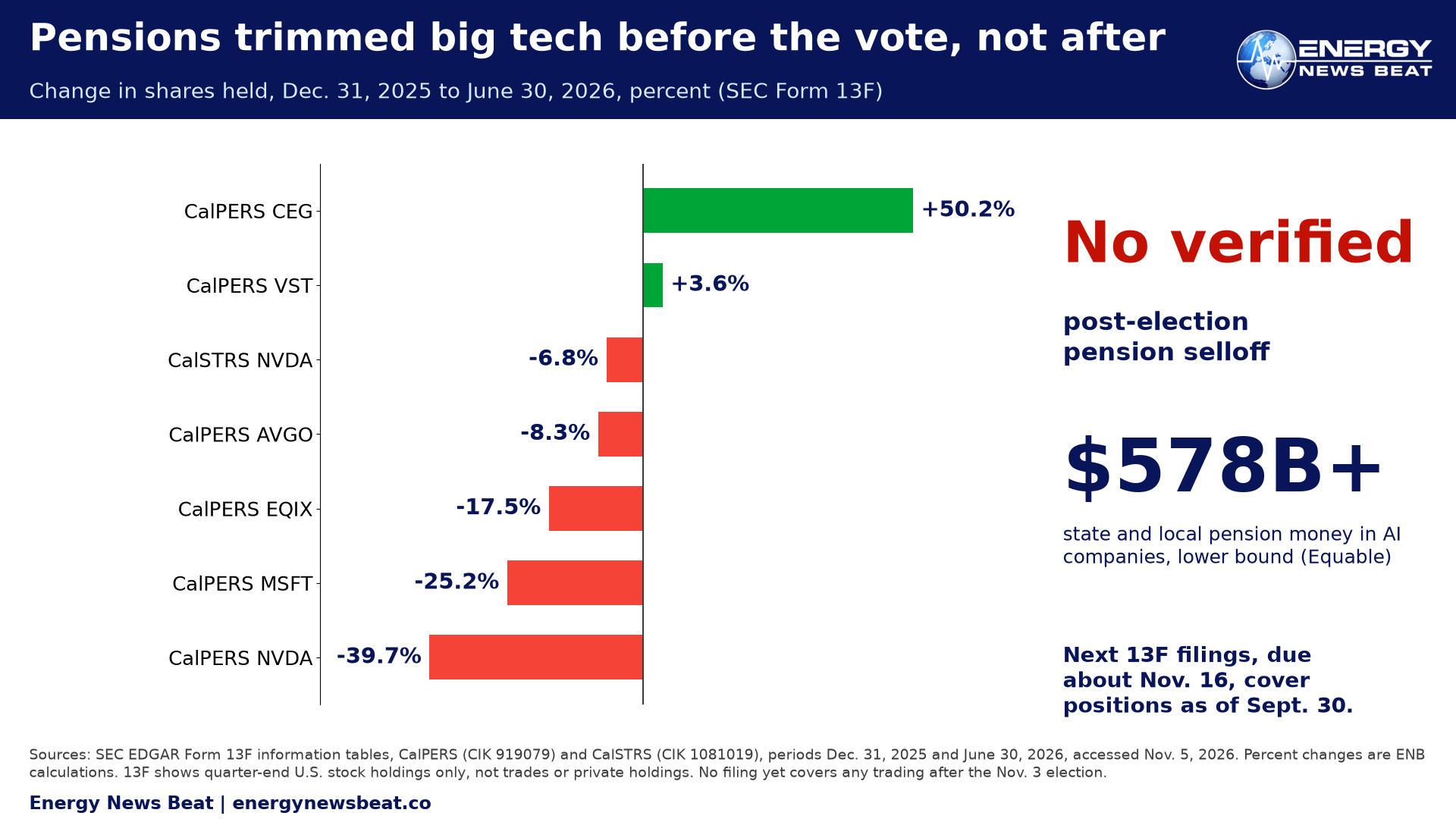
The exposure is real. Equable Institute estimates at least $578 billion of state and local pension money sits in AI companies, including $65.2 billion at CalPERS, $34.1 billion at New York Common and $13.7 billion at Texas Teachers (Equable). A CalPERS board member, Lisa Middleton, asked, “At what point do we need to start looking to what the downside could be?” (New York Times). Watch the September filings due around Nov. 16.
Who pays
For households, the risk runs the other way. If data centers slow down, the worry is stranded grid upgrades. If they speed up, it is new transmission and generation. Senate Bill 6’s transmission cost review and the PUC’s $50,000 per megawatt security are designed so large loads, not homes, carry those costs. Hinojosa has promised to “freeze residential electricity rates” (Hinojosa campaign). We found no detail on how a freeze would work in a competitive market.
Caveats and criticism
Thursday figures are intraday and will change. Bloomberg’s story is mostly paywalled; we credit only its lede. A slower buildout can be better for ratepayers and worse for jobs and local tax bases. The Data Center Coalition argues the sales tax break pays for itself in jobs and local taxes (Texas Tribune), and the Texas Senate must confirm any new PUC commissioners. Policy talk is also cheap until rules are written. Pension data lag, too: Form 13F reports arrive up to 45 days after a quarter ends, so no public filing yet shows what any fund did this week (SEC). One or two trading days of prices cannot prove what traders were thinking.
| STU’S TAKE
Opinion. Every number is linked to its source. This is my view. The market did not just learn that data centers are dead. It learned they will cost more and take longer. On Wednesday, Vistra fell 13.8 percent (Nasdaq.com) while Equinix rose 3.9 percent. Thursday’s rout came after Qualcomm’s outlook and Arm’s report (NBC; CNBC). Texas already paused: ERCOT stopped energizing new data centers of 75 megawatts or larger on Aug. 3 (ERCOT), and on Sept. 21 Abbott froze state environmental permits for data centers (Governor’s office). My friend David Blackmon shows the cost in Forbes: a $250 million project its CEO says went to Wyoming (Forbes). Governor-elect Hinojosa’s real power is five PUC seats (Utilities Code) and a sales tax break the state forecast would cost $3.2 billion over two years, which the Legislature already wants to fix (Texas Tribune). Make the data centers pay their own way and keep the lights on for families. And no, I cannot show you a pension fire sale. CalPERS cut Nvidia 39.7 percent before the election (SEC). |
Appendix
Sources, verbatim excerpts, data tables and methodology for this article. Closing prices are for Nov. 3 and Nov. 4, 2026. Nov. 5 index values are delayed intraday quotes and stock prices are real-time intraday quotes, taken 9:52 to 9:54 a.m. CT; not closes. Pension holdings are as of Dec. 31, 2025 and June 30, 2026, unless noted.
A. Sources, with links and access dates
All accessed Nov. 5, 2026.
- Bloomberg Markets Wrap, “Nasdaq 100 Sinks 6% as Chipmaker Selloff Deepens” (headline as of 9:53 a.m. CT Nov. 5; lede only; rest paywalled) Open at bloomberg.com
- CNBC live updates, Nov. 4 session (S&P 500 and Dow closes) Open at cnbc.com
- CNBC live updates, Nov. 5 session (Qualcomm, MRB Partners, OpenAI) Open at cnbc.com
- AP, Wall Street close, Nov. 4 Open at apnews.com
- NBC News, tech stocks plunge, Nov. 5 Open at nbcnews.com
- StockAnalysis news, Nasdaq 100 falls as chip stocks slide (UBS note, Micron) Open at stockanalysis.com
- Reuters via Investing.com, Nasdaq 100 eyes $1.8 trillion loss as Democratic win sparks AI delay fears (UBS note) Open at investing.com
- Investing.com (Louis Juricic), Vistra plunges 13.5% as Texas election rattles AI power trade; KeyBanc downgrades Open at investing.com
- Reuters via Investing.com, Texas data centers face uncertain future after Hinojosa wins Open at investing.com
- Nasdaq.com historical data, Nasdaq 100, Nasdaq Composite (same pattern) and quote pages Open at nasdaq.com
- Nasdaq.com historical data, PHLX Semiconductor index Open at nasdaq.com
- Nasdaq.com historical data, stocks (Vistra shown; same pattern for every ticker in table C2) Open at nasdaq.com
- MarketWatch, data center stocks after Democrats win Congress (Glenmede) Open at marketwatch.com
- Fortune, Democrats and anti-data-center governors (Dan Ives of Yorkville Ives; Acton, Bottoms) Open at fortune.com
- Latitude Media, how the Democratic sweep will rewire data center policy (Bank of America) Open at latitudemedia.com
- Politico, AI boom meets blue-state roadblock (lede and summary only) Open at politico.com
- Tech Policy Press, Democratic victory speeches on AI and data centers Open at techpolicy.press
- Texas Tribune, Under Hinojosa, data center approvals could stay paused, Nov. 4 Open at texastribune.org
- Texas Tribune, sales tax exemption for data centers growing while audits lag, July 27 Open at texastribune.org
- Movement Voter Project results page, Texas governor (AP call time, vote shares) Open at movement.vote
- Fort Worth Star-Telegram, Hinojosa unseats Abbott (AP and Secretary of State counts) Open at star-telegram.com
- PUCT, Order adopting 16 TAC 25.194, Project 58481 (unsigned adoption order) Open at ftp.puc.texas.gov
- Hinojosa campaign statement, Sept. 18, 2026 Open at ginafortexas.com
- Office of Gov. Kathy Hochul, statewide moratorium on new hyperscale data centers, July 14 Open at governor.ny.gov
- ERCOT Board, Batch Zero update, Sept. 14 to 15, 2026 Open at ercot.com
- Texas Senate Bill 6, 89th Legislature, enrolled text Open at capitol.texas.gov
- Texas AI Docket summary of PUCT Project 58481 large-load interconnection rule Open at texasaidocket.com
- Texas Utilities Code Section 12.051, appointment and terms of PUC commissioners Open at law.justia.com
- Texas Comptroller, data center sales tax exemption Open at comptroller.texas.gov
- Texas Comptroller, Jobs, Energy, Technology and Innovation Act (JETI) Open at comptroller.texas.gov
- SEC EDGAR, CalPERS Form 13F, period Dec. 31, 2025 Open at sec.gov
- SEC EDGAR, CalPERS Form 13F, period June 30, 2026 Open at sec.gov
- SEC EDGAR, CalSTRS Form 13F, period Dec. 31, 2025 Open at sec.gov
- SEC EDGAR, CalSTRS Form 13F, period June 30, 2026 Open at sec.gov
- Bloomberg Law summary of Financial Times report on CalPERS tech cuts, Oct. 23 Open at news.bloomberglaw.com
- New York Times report by Tony Romm, reprinted by NWA Democrat-Gazette, Nov. 1 Open at nwaonline.com
- Equable Institute, pension fund AI exposure media brief, October 2026 Open at equable.org
- PitchBook, Texas Teachers CIO warns AI capex boom echoes past busts (headline and summary only) Open at pitchbook.com
- SEC, Form 13F frequently asked questions (filing deadline) Open at sec.gov
- David Blackmon, Forbes, Texas Will Learn The Economic Cost Of Saying No To Data Centers, Nov. 5, 2026 Open at forbes.com
- Office of the Texas Governor, Governor Abbott Directs Comprehensive Data Center Audit, Aug. 3, 2026 Open at gov.texas.gov
- Office of the Texas Governor, Governor Abbott Directs TWDB To Penalize Data Center Reporting Failures, Sept. 14, 2026 Open at gov.texas.gov
- Office of the Texas Governor, Governor Abbott Directs TCEQ To Halt Data Center Permits, Sept. 21, 2026 Open at gov.texas.gov
- TCEQ letter to Gov. Abbott responding to the Sept. 21 directive, Oct. 19, 2026 Open at tceq.texas.gov
- TCEQ, STEERS Is Temporarily Down (notice) Open at tceq.texas.gov
- Texas Tribune, TCEQ shuts down permit filing system amid data center dispute, Oct. 21, 2026 Open at texastribune.org
- Texas Politics Project, UT/TxPP Poll, Aug. 5 to 13, 2026 Open at texaspolitics.utexas.edu
B. Excerpts
“A post-election slide in chipmakers snowballed, dragging the Nasdaq 100 down 5%, as investors bailed from the sector on speculation the Democratic sweep in Congress will usher in a new era of regulation for the artificial-intelligence industry.” (Bloomberg lede) Open at bloomberg.com
“The sell-off was triggered by two lackluster earnings reports from major chipmakers, Qualcomm and Arm Holdings.” (NBC News) Open at nbcnews.com
“A shakeout among the most speculative parts of the theme is underway… The U.S. mid-term election results will add to headwinds for big tech and the data center buildout.” (MRB Partners, via CNBC) Open at cnbc.com
“Data center pauses will slow the pace of buildout into 2028.” (UBS, via StockAnalysis) Open at stockanalysis.com
“Tech needs to adjust and focus on a slower pace of this AI rollout.” … “Now it will happen at a more measured pace which is likely a good thing in the eyes of many investors…and the market will digest this news and move forward.” (Dan Ives, Yorkville Ives, via Fortune) Open at fortune.com
Acton’s pause plus her power to appoint utility regulators could make the debate “more durable than a campaign-only issue.” (Bank of America, via Latitude Media) Open at latitudemedia.com
“When I am governor I will issue a moratorium — a ban — on all data center approvals until laws can be passed by the Legislature to protect Texans.” (Gina Hinojosa, Oct. 22 video, via Texas Tribune) Open at texastribune.org
Moratorium to last until the Legislature passes “real protections so Texans can have a seat at the table to decide if and how data centers come into their communities.” (Hinojosa, via Texas Tribune) Open at texastribune.org
“We can have economic development and we can have protections for Texans. These things are not mutually exclusive.” (Hinojosa, September interview with Politico, via Texas Tribune) Open at texastribune.org
Hinojosa vowed days before the vote to “stop the data center takeover.” (Reuters) Open at investing.com
“On Day One as governor, I’ll freeze residential electricity rates and make corporations finally pay their fair share.” (Hinojosa campaign statement, Sept. 18) Open at ginafortexas.com
“We’ve just seen real anger in communities — big, small, in solid red counties and in deep blue counties alike.” (Kathryn Guerra, Public Citizen, via Texas Tribune) Open at texastribune.org
“As data center development threatens to hike up utility bills, deplete our natural resources, and create uncertainty for New Yorkers, it’s my responsibility to take action and lead.” (Gov. Kathy Hochul, July 14) Open at governor.ny.gov
“I do not work for data centers.” (Sen.-elect Sherrod Brown) | “We enacted the toughest AI regulations in the country.” (Gov. JB Pritzker) | “…big tech doesn’t get to write the rules that shape our future, but instead the folks in our local communities get the final say.” (Gov. Josh Shapiro) (victory speeches, via Tech Policy Press) Open at techpolicy.press
“We have vastly, vastly more certifications for exemption that have been granted since that last estimate was done… The next estimate will be significantly higher.” (Brad Reynolds, Texas Comptroller’s Office, via Texas Tribune) Open at texastribune.org
ERCOT, Aug. 3: “Paused approvals to energize data centers or virtual currency mining facilities (crypto facilities) that are 75 MW or greater.” Batch Zero: 204 projects (66.4 GW) conditionally base load; 158 projects (127.9 GW) conditionally studied load. (ERCOT Board presentation) Open at ercot.com
Senate Bill 6: large-load threshold of “75 megawatts unless the commission determines that a lower threshold is necessary”; new loads “interconnected after December 31, 2025” to be curtailed during firm load shed; PUC to evaluate whether “transmission cost recovery appropriately charges the system costs that are caused by each customer class.” (enrolled text, excerpts) Open at capitol.texas.gov
CalPERS “traded large concentrated exposure to those seven companies for exposure to several hundred firms via private equity.” (Anton Orlich, deputy CIO, as summarized from the Financial Times by Bloomberg Law) Open at news.bloomberglaw.com
“The market is even more reliant now on tech than it has ever been… At what point do we need to start looking to what the downside could be?” (Lisa Middleton, CalPERS board, via New York Times) Open at nwaonline.com
“Governor Greg Abbott today directed the Public Utility Commission of Texas (PUCT) and the Electric Reliability Council of Texas (ERCOT) to conduct a comprehensive verification and audit of all data centers advancing through ERCOT’s interconnection process.” (Governor’s office, Aug. 3, 2026) Open at gov.texas.gov
“Governor Greg Abbott today directed the Texas Water Development Board (TWDB) to compel major water users, including data centers, to comply with water use reporting requirements…” (Governor’s office, Sept. 14, 2026) Open at gov.texas.gov
“Governor Greg Abbott today directed the Texas Commission on Environmental Quality (TCEQ) to halt all permits sought by data centers until the Electric Reliability Council of Texas (ERCOT) completes its audit.” (Governor’s office, Sept. 21, 2026) Open at gov.texas.gov
“TCEQ has paused the issuance of all permits related to the construction or development of infrastructure directly supporting data centers.” (TCEQ letter to Gov. Abbott, Oct. 19, 2026) Open at tceq.texas.gov
“STEERS has been temporarily shut down to ensure all applications related to data centers are reviewed by TCEQ staff in accordance with the Governor’s directive related to data centers dated Sept. 21, 2026… TCEQ anticipates that this work will be completed in mid-November.” (TCEQ notice) Open at tceq.texas.gov
“The next thing we did was take this client and move the whole project to Wyoming.” Lost Permian campus: “three to four billion dollars on the data center build-out, not including the compute.” (Balaji Tammabattula, BaRupOn CEO, to David Blackmon, Forbes) Open at forbes.com
“We’re not even connected to the grid. Your bills are not going up because of us.” “I personally feel that it’s not the same Texas I experienced three years ago.” (Tammabattula, Forbes) Open at forbes.com
“Now that Hinojosa has easily won the election, Abbott’s moratorium pending a study could well become permanent Texas policy with wide-ranging negative economic consequences.” (David Blackmon, Forbes) Open at forbes.com
Tammabattula’s account, as reported by Blackmon: protesters “none of the locals recognized” demanded a 24-month delay at a town hall, then “disappeared. No names, no nothing.” (Forbes; not independently verified) Open at forbes.com
“For the second consecutive survey, a majority of Texans, 57%, said that they oppose the construction of a data center in their community.” Rural voters: 60% opposed. (Texas Politics Project, poll conducted Aug. 5 to 13, 2026) Open at texaspolitics.utexas.edu
C. Data tables, with as-of dates
C1. Index levels: Nov. 3 and Nov. 4 closes, Nov. 5 intraday at 9:52 a.m. CT (Nasdaq.com; S&P 500 and Dow from CNBC)
| Index | Nov. 3 close | Nov. 4 close | Nov. 4 change | Nov. 5 intraday | Nov. 5 change |
| Nasdaq 100 | 28,180.26 | 28,437.17 | +0.91% | 26,661.17 | -6.25% |
| Nasdaq Composite | 25,372.01 | 25,736.51 | +1.44% | 24,299.75 | -5.58% |
| PHLX Semiconductor | 10,600.40 | 10,268.65 | -3.13% | 9,076.46 | -11.61% |
| S&P 500 | 7,688.62 | +1.58% | not captured | ||
| Dow Jones Industrial Average | 53,356.12 | +3.03% | not captured |
C2. Stocks: Nov. 3 and Nov. 4 closes, Nov. 5 intraday change at 9:54 a.m. CT (Nasdaq.com)
| Ticker | Company | Group | Nov. 3 | Nov. 4 | Nov. 4 change | Nov. 5 intraday |
| VST | Vistra | Texas power | 139.59 | 120.29 | -13.83% | -7.61% |
| NRG | NRG Energy | Texas power | 96.26 | 83.25 | -13.52% | -3.08% |
| TLN | Talen Energy | Power | 357.28 | 326.78 | -8.54% | not captured |
| CEG | Constellation | Power | 263.40 | 245.72 | -6.71% | -5.52% |
| SRE | Sempra (Oncor parent) | Utility | 85.36 | 82.90 | -2.88% | -2.86% |
| GEV | GE Vernova | Grid equipment | 918.20 | 832.83 | -9.30% | -9.63% |
| CRWV | CoreWeave | AI cloud | 53.74 | 48.42 | -9.90% | -15.32% |
| NVDA | Nvidia | Chips | 206.69 | 200.13 | -3.17% | -8.54% |
| AVGO | Broadcom | Chips | 332.13 | 325.48 | -2.00% | not captured |
| ARM | Arm Holdings | Chips | 202.49 | 191.80 | -5.28% | not captured |
| QCOM | Qualcomm | Chips | 164.43 | 173.19 | +5.33% | not captured |
| EQIX | Equinix | Data center REIT | 1,014.40 | 1,054.09 | +3.91% | -5.72% |
| DLR | Digital Realty | Data center REIT | 180.25 | 184.88 | +2.57% | -5.37% |
| MSFT | Microsoft | Hyperscaler | 520.99 | 555.80 | +6.68% | -3.97% |
| AMZN | Amazon | Hyperscaler | 250.69 | 266.03 | +6.12% | -4.69% |
C3. Pension holdings in SEC Form 13F, shares (as of Dec. 31, 2025 and June 30, 2026)
| Fund | Ticker | Dec. 31, 2025 | June 30, 2026 | Change (ENB calc) | Filing |
| CalPERS | NVDA | 76,375,762 | 46,071,341 | -39.7% | SEC EDGAR |
| CalPERS | MSFT | 21,124,113 | 15,795,039 | -25.2% | SEC EDGAR |
| CalPERS | AVGO | 13,616,185 | 12,483,106 | -8.3% | SEC EDGAR |
| CalPERS | CEG | 575,154 | 864,092 | +50.2% | SEC EDGAR |
| CalPERS | VST | 624,513 | 647,243 | +3.6% | SEC EDGAR |
| CalPERS | EQIX | 205,614 | 169,693 | -17.5% | SEC EDGAR |
| CalSTRS | NVDA | 37,569,999 | 35,021,490 | -6.8% | SEC EDGAR |
C4. Estimated public pension exposure to AI companies, as of June 30, 2026 (Equable Institute, lower-bound estimates)
| Fund | AI holdings | Share of assets |
| CalPERS | $65.2 billion | 10.4% |
| CalSTRS | $46.2 billion | 11.0% |
| New York State Common | $34.1 billion | 11.5% |
| Texas Teachers (TRS) | $13.7 billion | 5.3% |
| All state and local pensions (lower bound) | $578.1 billion to $706.6 billion | 9% to 11% |
C5. Texas data center rules and programs (as of Nov. 5, 2026)
| Item | What it does | Source |
| Senate Bill 6 (2025) | 75 MW large-load threshold; new large loads connected after Dec. 31, 2025 curtailable in firm load shed; PUC review of transmission cost allocation by customer class | Texas Legislature |
| PUCT rule, Project 58481 | Intermediate agreement, disclosures and $50,000 per MW financial security for new interconnections of 75 MW or more; effective Oct. 8, 2026 per Texas AI Docket (date not in the adoption order) | PUC order; Texas AI Docket |
| ERCOT pause | Aug. 3, 2026: energization of new data centers and crypto mines of 75 MW or more paused; reports due Dec. 10, 2026 | ERCOT |
| ERCOT Batch Zero | 204 projects, 66.4 GW base load; 158 projects, 127.9 GW studied load (125.4 GW on slide 6) (conditional, Sept. 3, 2026) | ERCOT |
| PUC appointments | Five commissioners appointed by the governor with Senate consent, staggered six-year terms | Utilities Code 12.051 |
| Sales tax exemption | State 6.25% sales tax on qualifying equipment and electricity; 2025 forecast cost $3.2 billion over two years | Comptroller; Texas Tribune |
| JETI | 10-year school M&O value limitation; agreement among company, school district and Governor’s office | Comptroller |
C6. Texas data center pause timeline, reconciled against primary sources
| Date | Action | Primary source |
| Aug. 3, 2026 | Abbott directs PUC and ERCOT to audit all data centers in the interconnection process; ERCOT market notice pauses Batch Zero and approvals to energize data centers and crypto mines of 75 MW or more | Governor’s office; ERCOT |
| Sept. 14, 2026 | Abbott directs the Water Development Board to enforce water-use reporting by data centers and join the ERCOT audit | Governor’s office |
| Sept. 21, 2026 | Abbott directs TCEQ to halt all permits sought by data centers until the ERCOT audit is complete | Governor’s office |
| Oct. 19, 2026 | TCEQ reports it has paused permits for infrastructure directly supporting data centers and is suspending some existing authorizations | TCEQ letter |
| Oct. 21, 2026 | TCEQ takes its STEERS electronic filing system offline; expects work done in mid-November | TCEQ notice; Texas Tribune, Oct. 21 |
| Dec. 10, 2026 | ERCOT eligibility verification and community impact reports due to the PUC | ERCOT |
D. Methodology
- Nov. 3 and Nov. 4 closes come from the Nasdaq.com historical data service and were checked against CNBC where available. S&P 500 and Dow closes are from CNBC and AP. Percent changes are Energy News Beat calculations from the closes.
- Nov. 5 figures are intraday quotes from Nasdaq.com taken 10:52 to 10:54 a.m. ET (9:52 to 9:54 a.m. CT): index values are delayed; stock quotes were flagged real-time. They are not closes. The 5 percent in Bloomberg’s lede was an earlier reading; its headline read 6 percent at 9:53 a.m. CT.
- Batch Zero: slide 2 of the ERCOT deck gives 66.4 GW base plus 127.9 GW studied (194.3 GW); slide 6 gives 125.4 GW for the 158 studied projects (191.8 GW). We report about 192 to 194 GW.
- PUC rule: the $50,000 per MW requirement is in the unsigned adoption order; the Oct. 8 effective date is not stated there and comes from the Texas AI Docket.
- Bloomberg’s story was read only to the end of the lede. No Bloomberg figure beyond the lede is used.
- Pension share counts come from Form 13F information tables on SEC EDGAR. Percent changes are Energy News Beat calculations. In the CalSTRS June 30, 2026 table, the value and share fields appear transposed; we read Nvidia as 35,021,490 shares worth about $7.0 billion, consistent with the market price. CalPERS Broadcom figures are rounded to the nearest 10,000 shares.
- 13F filings cover U.S.-listed stocks only, not private equity, bonds or foreign holdings, and show quarter-end snapshots, not trades. A drop in shares can reflect index rebalancing or manager decisions as well as policy.
- Market correlation with the election is described, not proven. No regression or event study was run.
- All times are Central Time unless marked ET.
- Texas timeline reconciled against primary sources: Governor’s office releases (Aug. 3, Sept. 14, Sept. 21), the ERCOT Board presentation (Aug. 3 market notice; Dec. 10 report deadline), the TCEQ letter of Oct. 19 and the TCEQ STEERS notice. Blackmon’s dates match these; his September poll date does not match the poll’s own August field dates.
E. Could not verify
- A post-election pension selloff of AI, chip or tech stocks. No filing, board minute or official release we found shows one. September 30 13F filings are due around Nov. 16 and will not show November trades.
- Any link between CalPERS or CalSTRS tech cuts and the election or state policy. The CalPERS cuts were described as concentration management and predate the vote.
- Texas Employees Retirement System (ERS) AI or tech holdings changes. No data found.
- New York Common Retirement Fund data center exposure (about $180 million in one data center fund, reported by a newsletter, not confirmed by the fund).
- Texas Teachers CIO Jase Auby’s exact words; PitchBook article could not be loaded beyond its headline and summary.
- Reports that some foreign pension funds exited Nvidia and Microsoft (low-quality aggregator; not U.S. public pensions).
- Bloomberg content beyond the lede, including any figures in its later paragraphs.
- A Scripps report of a 57 percent to 41 percent Hinojosa margin; it conflicts with AP and Secretary of State counts showing 52.8 to 45.7 percent.
- Goldman Sachs estimate of about 45 percent of planned capacity at risk (seen only in an Economic Times report).
- Raymond James and Evercore ISI quotes (seen only on an investing blog; not used in the body).
- Politico article beyond its lede and summary, including the Cleanview 41 percent figure.
- Whether a Texas governor has legal authority to impose a statewide moratorium by executive order. Not tested; Abbott worked through ERCOT and agency directives.
- Whether data centers qualify for JETI agreements by NAICS code.
- A statewide Texas data center water law. None found.
- ERCOT’s total large-load queue (reported above 400 GW by Reuters and 474 GW by an industry newsletter); ERCOT’s own September Batch Zero figures are used instead.
- How a residential rate freeze would work in ERCOT’s competitive retail market.
- Kansas governor’s race outcome and data center positions.
- BaRupOn’s Wyoming move, the $250 million project size and the $3 billion to $4 billion lost-campus estimate. These are Tammabattula’s statements to Forbes; we found no filing or second source.
- The town hall of unrecognized protesters. This is Tammabattula’s account only, as reported by Blackmon.
- LAMP Texas power plans (60 MW this fall, 240 MW in 2027, up to 3 GW, Kinder Morgan gas supply). Company plans as reported by Forbes; not confirmed with Kinder Morgan.
- Poll timing. Blackmon dates the Texas Politics Project poll to September; the poll itself was conducted Aug. 5 to 13, 2026. We use the poll’s own dates.
- The exact day TCEQ took STEERS offline. The TCEQ notice is undated; Oct. 21 is from the Texas Tribune.

