

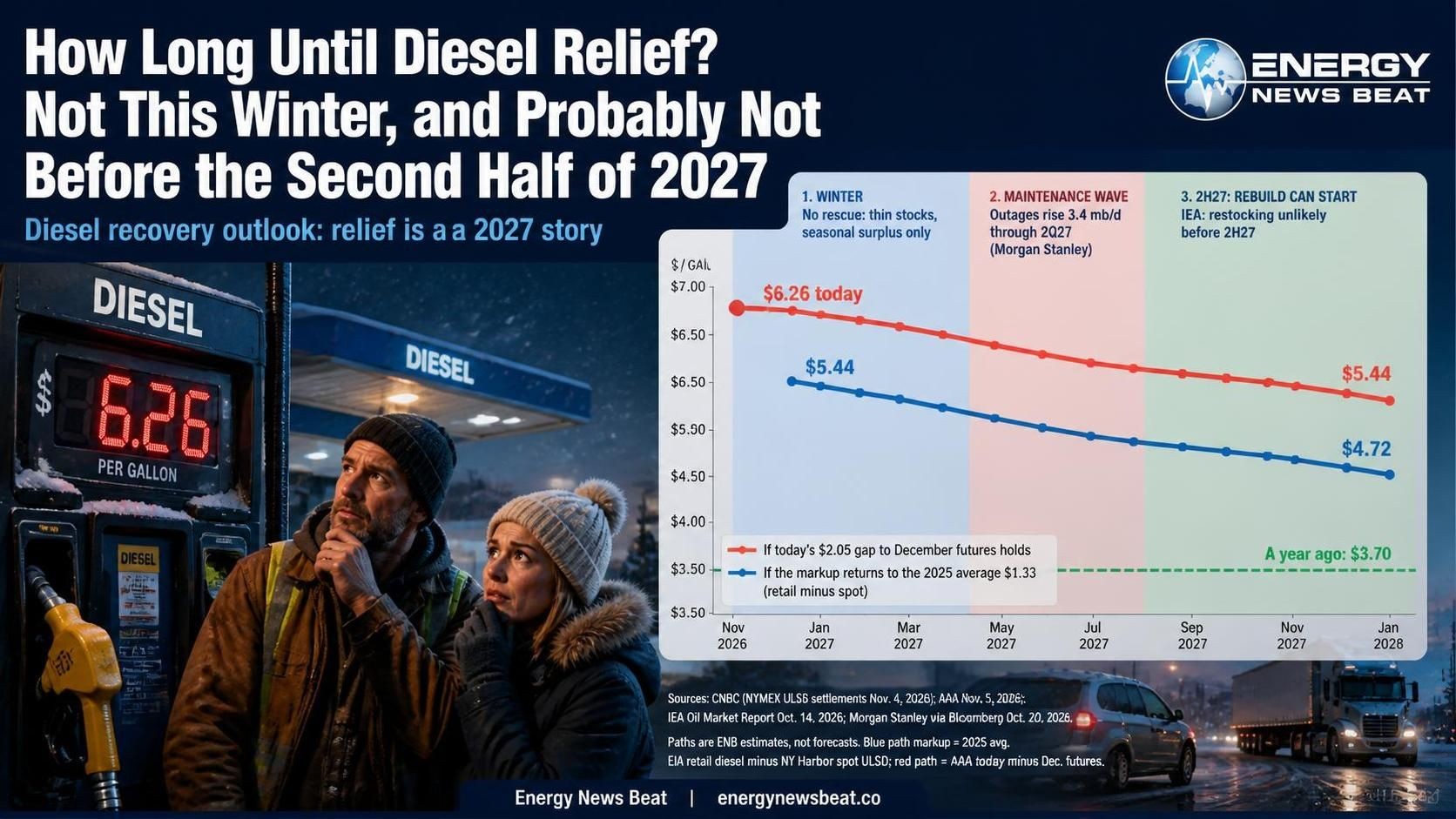
Diesel is $6.26 a gallon, $2.55 more than a year ago, and U.S. stocks just hit the lowest level for this time of year in EIA records. Wholesale prices have eased since our Oct. 14 report, but the IEA still says lost inventories are unlikely to be rebuilt before the second half of 2027. Here is the recovery clock, and what could move it.
By Stuart Turley, host of the Energy News Beat podcast
Published Nov. 5, 2026 | Pump prices as of 6:36 a.m. CT Nov. 5 (AAA) | Futures: Nov. 4 settlements, read 6:27 a.m. CT Nov. 5 | An update to our Oct. 14 report | Not investment advice
An update to our Oct. 14 report, IEA Says the Diesel Squeeze Lasts Well Into 2027.
If you run a truck, a tractor or an oil furnace, you have been asking one question since spring: when does this end? Three weeks ago we put that question to the futures market, the government and the International Energy Agency in our Oct. 14 report. Since then, wholesale diesel has eased and voters have handed Congress to Democrats, though the new members are not seated until January (NPR). The answer has not changed much. Relief is coming, but it is a 2027 story, and most of it lands in the back half of the year.
Where diesel stands this morning
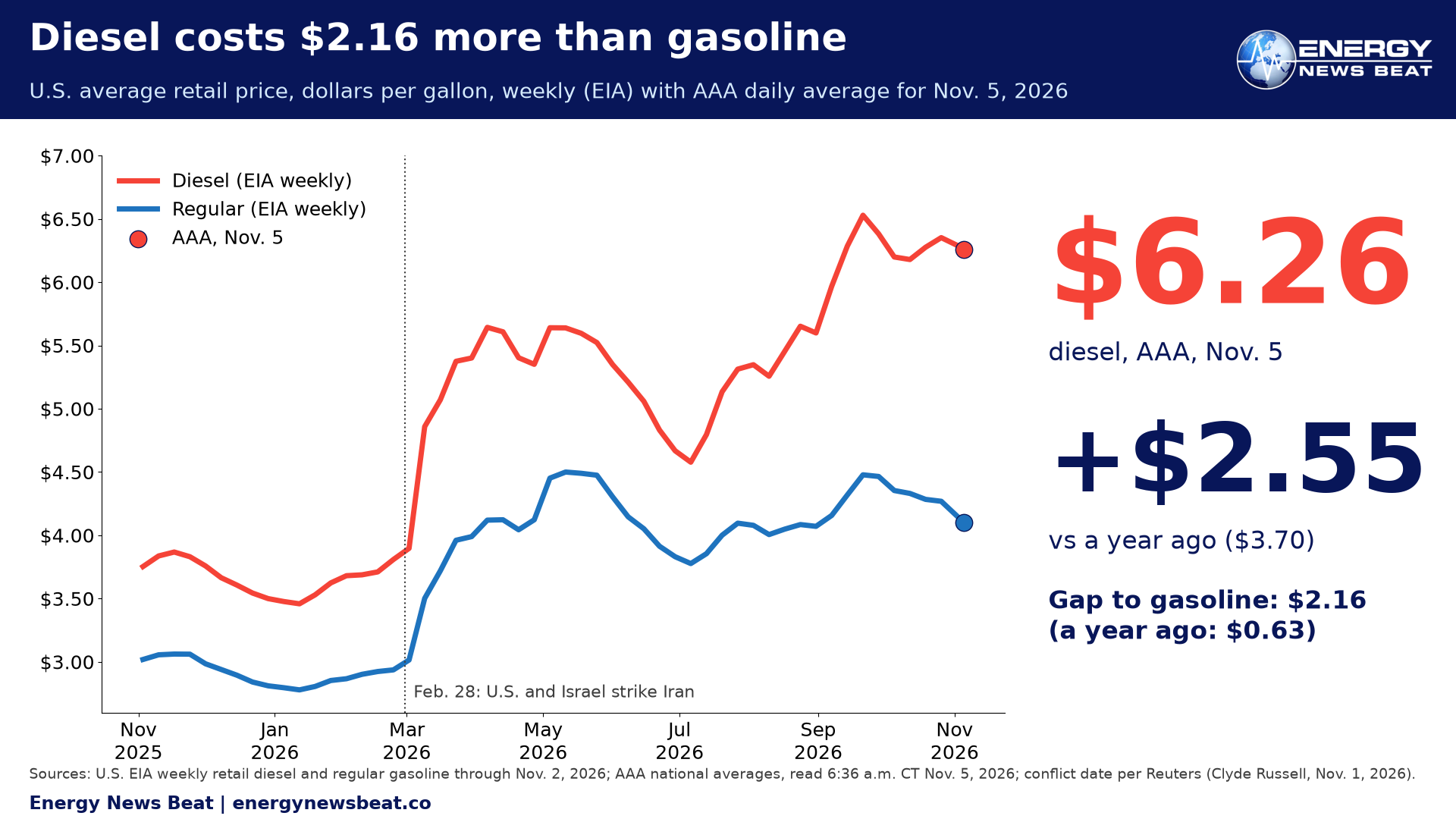
The national average for diesel was $6.256 a gallon this morning, per AAA. That is down 8 cents from a week ago and 27 cents under the record $6.528 set on Sept. 22, but still $2.55, or 69 percent, above a year ago. Regular gasoline was $4.100. Diesel now costs $2.16 a gallon more than gasoline; a year ago the gap was 63 cents.
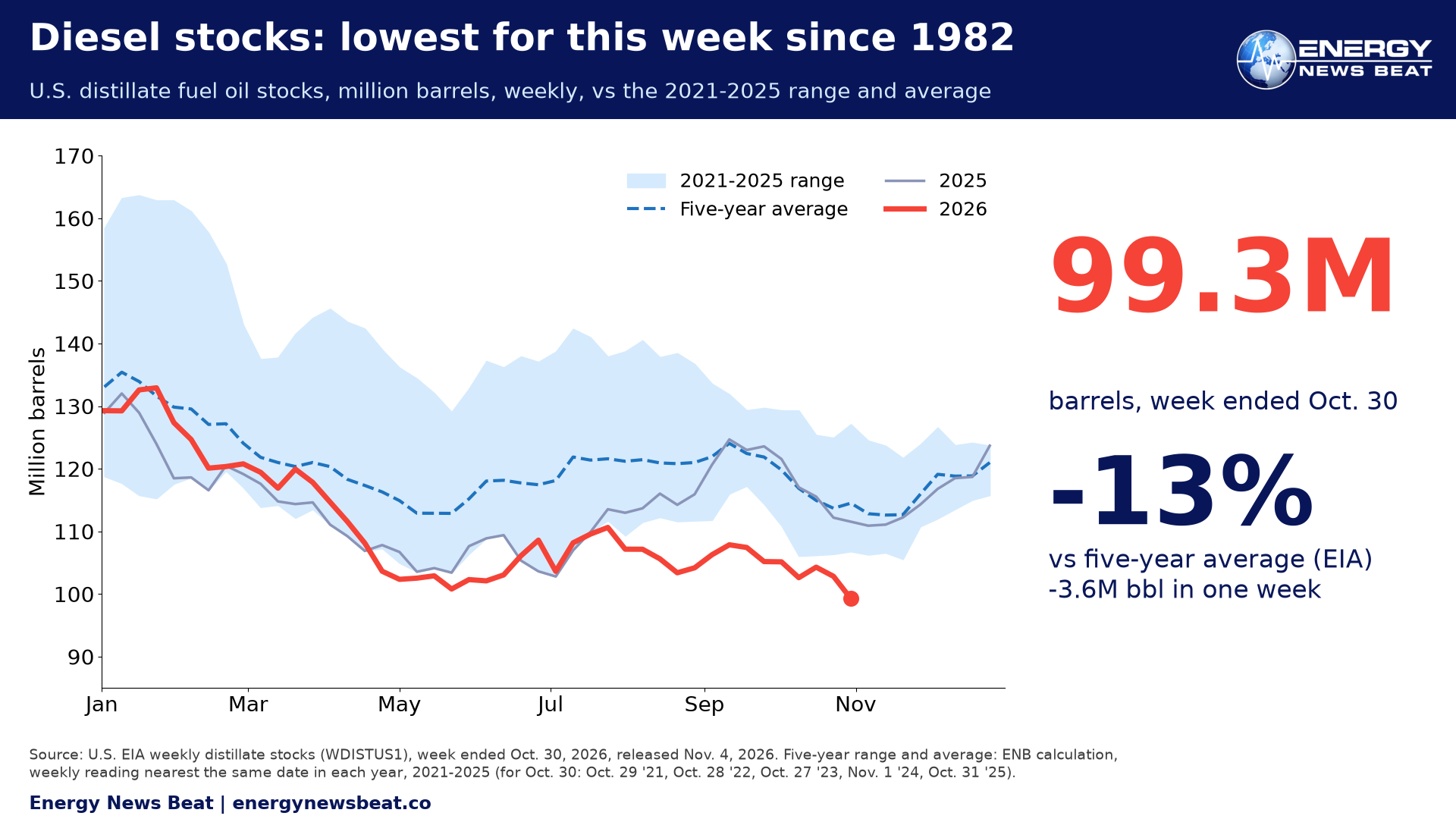
The shelves are thin. U.S. distillate stocks fell 3.6 million barrels in the week ended Oct. 30 to 99.3 million, the EIA reported Wednesday. Analysts polled by Reuters had expected a draw of only 100,000 barrels, per EnergyNow. EIA puts stocks 13 percent below the five-year average for this time of year. By our count from EIA’s weekly series, that is the lowest level for this week of the year in records going back to 1982, and 12.3 million barrels below a year ago. Demand is not helping: distillate supplied averaged 4.2 million barrels a day over four weeks, up 8.7 percent from last year, even with refineries running at 94.5 percent of capacity.
The recovery clock, in three stages
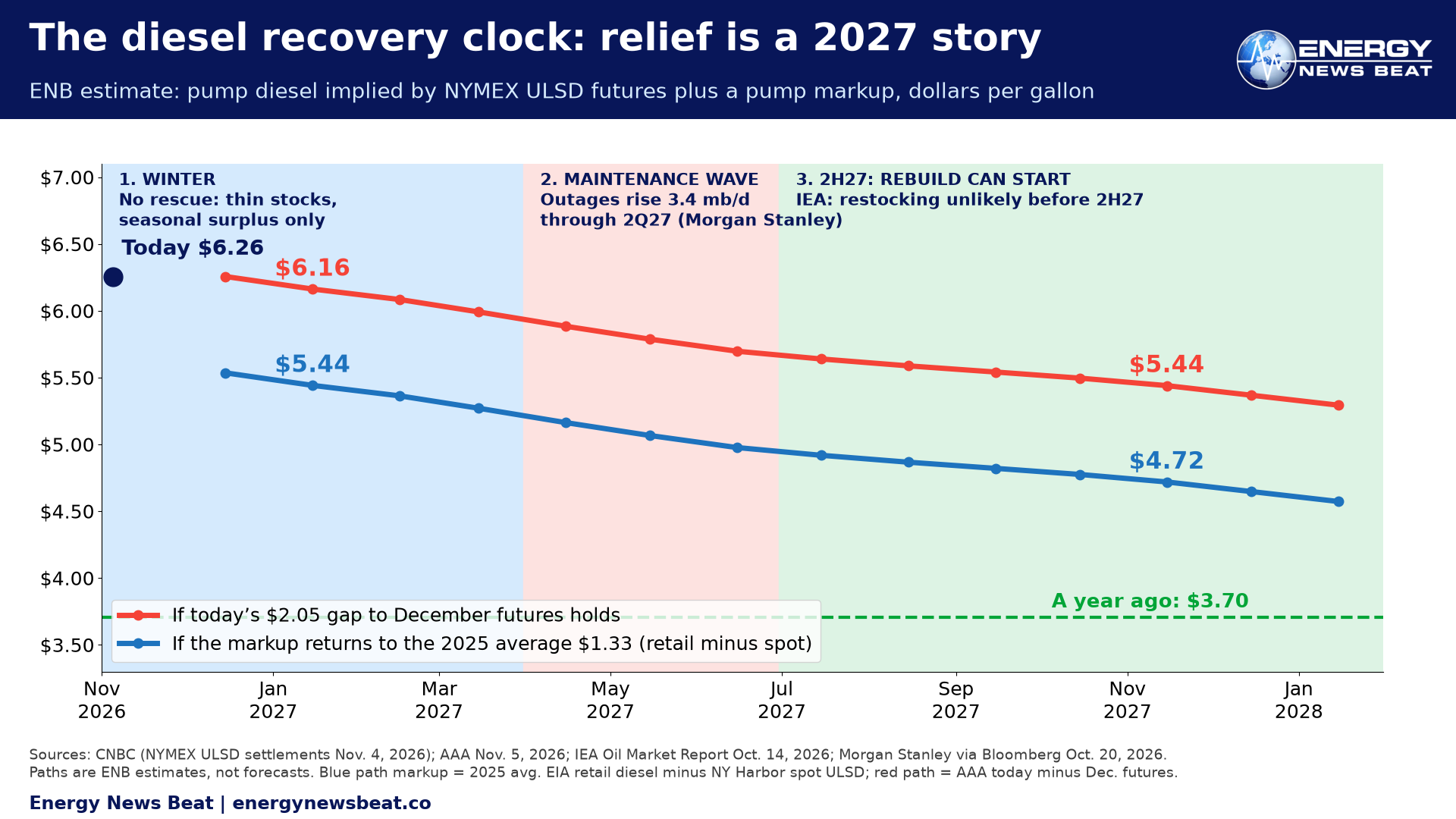
Stage one is this winter, roughly November through March: no rescue. The IEA’s October Oil Market Report says gasoil supply falls short of demand in the fourth quarter. It expects higher refinery output to return the market to a surplus in the first quarter of 2027, but only enough to lift stocks “broadly in line with normal seasonal patterns.” That can take the edge off prices. It does not refill the hole.
Stage two runs from spring to mid-2027, when the bill for running flat out comes due. Refiners have postponed maintenance to capture strong margins. Morgan Stanley analysts expect planned global refinery outages to rise by 3.4 million barrels a day through the second quarter of 2027, two and a half times the norm and more than the refining capacity now offline in the Middle East and Russia, Bloomberg reported. Maintenance “cannot be delayed indefinitely,” the bank’s strategists wrote, per OilPrice.com. The headline on Bloomberg’s story: fuel tightness persisting through mid-2027.
Stage three is the second half of 2027, when real rebuilding can start. The IEA says replenishing lost inventories, “outside of typical seasonal fluctuations, is unlikely before 2H27,” and that the market “will remain tight well into 2027 and is dependent on a recovery of product supply from the Middle East.” The hole is large: global observed stocks were 509 million barrels below pre-war levels at the end of September, and global diesel and gasoil availability was down 1.7 million barrels a day in the third quarter from a year earlier.
What the futures market says now
On Oct. 14 we estimated about $6 diesel into January, by adding 2025’s average $1.33 pump markup to NYMEX diesel futures. The futures have since dropped. January settled at $4.1117 a gallon on Nov. 4, per CNBC, down 56 cents from $4.6766 on Oct. 13. On the same math, that points to about $5.44 at the pump in January, $4.98 in June and $4.72 next November.
There is a catch. The pump has not followed the wholesale market down. This morning’s $6.256 sits $2.05 above the December futures settlement of $4.2055. Part of that is spot diesel still trading above futures; measured the way we measured last year’s $1.33, against New York Harbor spot, the gap is about $1.62, still wider than 2025. If today’s $2.05 gap to futures holds, January diesel is closer to $6.16. And even on the friendlier math, the futures market prices diesel about a dollar above last year’s pump price a full year from now. That is our estimate from public quotes, not a forecast.
What could speed it up
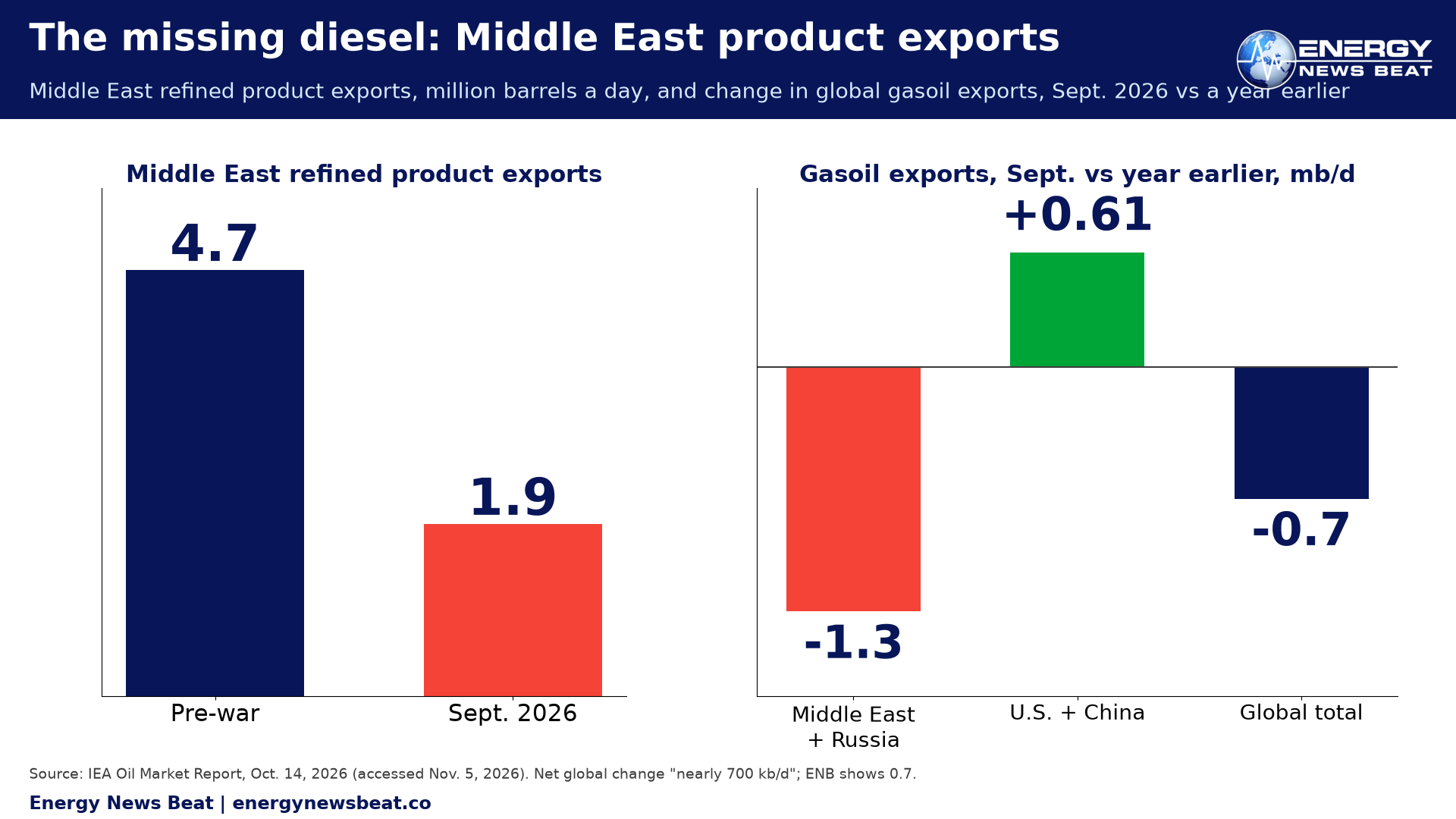
A durable deal that reopens the Strait of Hormuz is the big one. Asia’s crude imports are already back to 26.39 million barrels a day, near the 27.0 million pre-war average, but its imports of light and middle distillates were still 10 percent below pre-war in October, per Kpler data in a Reuters column by Clyde Russell. The IEA says Middle East refined product exports were 1.9 million barrels a day in September, against 4.7 million before the war. Getting those barrels back is what refills tanks.
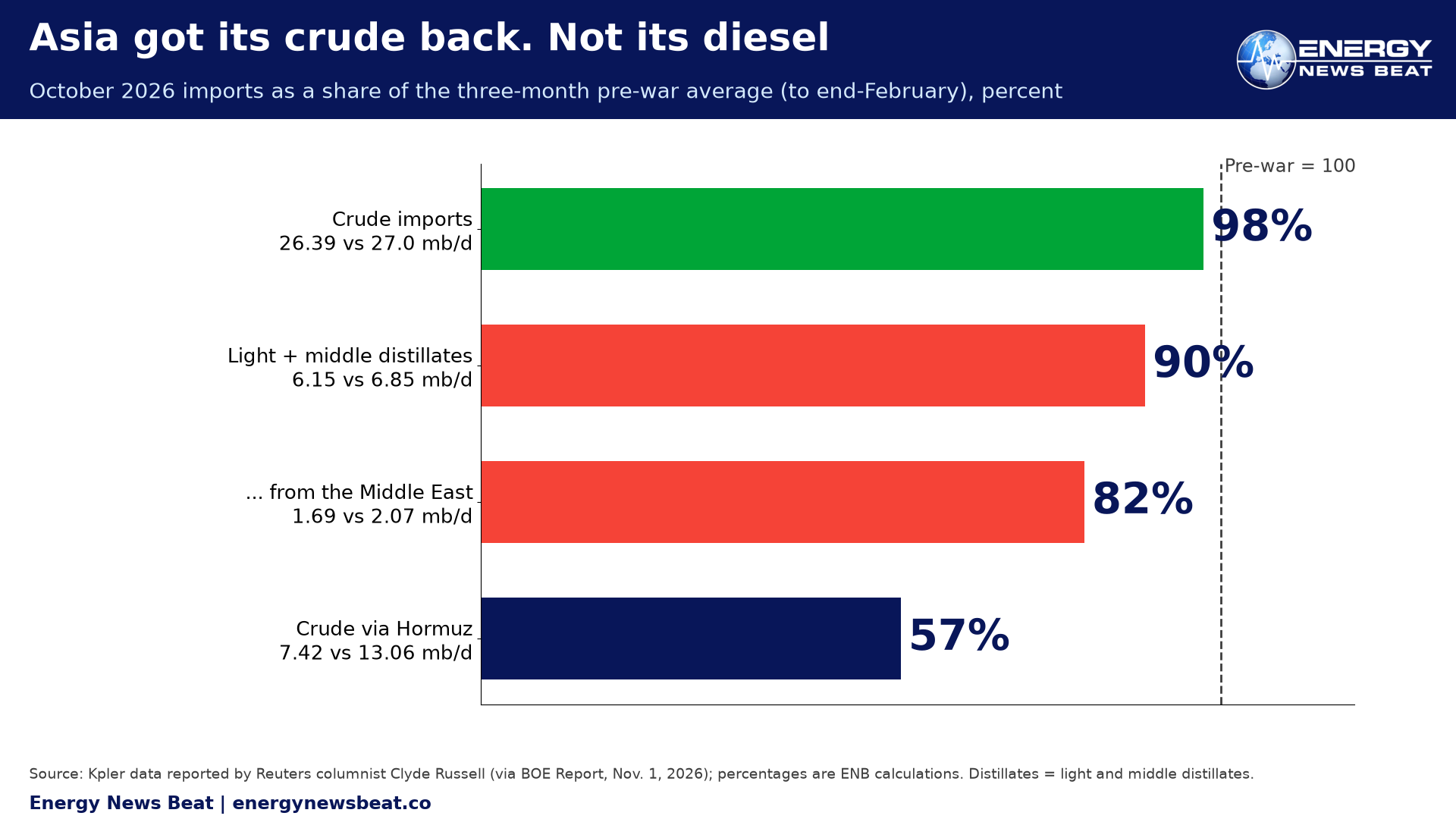
Smaller helps are lining up. Easing westbound freight is reopening the December diesel arbitrage from Asia to Europe, Sparta Commodities says, and Russian cargoes could add some relief. More Chinese export quotas would help: “China remains the main Asian uncertainty,” writes Sparta analyst Abhishek Kumar. The Energy Department on Nov. 4 awarded contracts to exchange 300,000 barrels from the Northeast Home Heating Oil Reserve, with deliveries by Nov. 6. That is about 8 percent of last week’s draw and, by our math, about 1.6 hours of U.S. distillate demand. Writing Oct. 28 about the department’s offer to lend up to 315,000 barrels, before this award, Sparta called it “more of a policy signal than a meaningful supply response.”
What could slow it down
The IEA warns that attacks on regional energy infrastructure and tanker traffic threaten the Gulf recovery, and that a late-season Gulf Coast hurricane could tighten the market further. If Ukraine keeps striking Russian refineries, diesel may not fall as fast as gasoline, because Russia normally supplies much of the world’s diesel, NPR reports, citing Rystad’s Jorge León. León also asked what happens if U.S. refineries, running above 90 percent of capacity, need emergency maintenance just as more crude arrives (NPR). A cold Northeast winter would pull hard on thin heating oil stocks. And the spring maintenance wave is already on the calendar.
What it means for consumers
Diesel moves the economy, so the bill shows up everywhere, not just at the truck stop. Every 100 gallons of diesel costs $625.64 at today’s average, against $370.49 a year ago, $255 more, by our math from AAA. Freight, farm inputs and delivery fees carry that cost into groceries and goods. For Northeast families heating with oil, the reserve release is welcome but tiny; locking in a price or a budget plan, where dealers offer one, may beat waiting for a winter drop that the inventory numbers do not promise. Fleet owners should plan budgets around diesel near or above $5 through mid-2027, not a quick return to $4.
What investors are watching
Refiners are the winners of a product shortage. Phillips 66 reported third-quarter earnings of $5.6 billion, or $14.08 a share, with 98 percent crude utilization and a third-quarter record 41 percent distillate yield, per its earnings release. Investors will watch whether those margins survive two things: the spring maintenance wave, which cuts volumes but supports prices, and any Hormuz deal, which could compress diesel cracks fast. The steep downward slope in the futures curve, from $4.21 for December to $3.39 for next November, says traders already expect some normalization. None of this is investment advice.
Caveats, and the case against our timeline
Our timeline could be too gloomy. Futures have fallen sharply in three weeks, and NPR reports Dow Jones Energy’s Jaime Brito sees a possible $15 to $20 a barrel drop in crude within two or three days of a deal that traders believe will last. Demand is also adjusting; the IEA notes consumers have deferred heating oil purchases at these prices. On the other side, the IEA report is three weeks old and does not reflect events since; its next monthly report could move the clock either way. The Morgan Stanley note is reported by Bloomberg and OilPrice.com, which word the 3.4 million barrel figure differently; we did not see the note itself. The Asia import data are Kpler figures as reported by a Reuters columnist. Our pump estimates are simple arithmetic on futures plus a markup, not a model. And U.S. stocks are a national total; regional shortages, especially in New England, can be worse or better.
| ALSO WORTH WATCHING: “Does the blue wave mean lower gasoline and diesel prices soon? Don’t hold your breath”
Related read from NPR, Nov. 5, 2026. NPR says the new Congress has limited direct power over fuel prices, and asked two analysts how fast pump prices could fall after a deal with Iran. Best case, Dow Jones Energy’s Jaime Brito says, about three months after a ceasefire or deal for gasoline and diesel to reach pre-war levels. Rystad’s Jorge León expects about six months for crude, then another month or two for fuels, and both warn hiccups could stretch it to a year. Brito’s bottom line: “you need to see a definitive end of the conflict.” Read NPR’s Nov. 5 story. |
| STU’S TAKE
Opinion. Every number is linked to its source. This is my view, and I will own it. Three weeks ago the IEA told us the diesel squeeze runs “well into 2027” (IEA). Nothing since has changed the math. Diesel is $6.256 this morning, $2.55 above a year ago (AAA). Our distillate stocks are 99.3 million barrels, 13 percent below the five-year average (EIA), the lowest for this week of the year since EIA records began in 1982 (EIA series). Washington’s answer was 300,000 barrels from the heating oil reserve (DOE). That is about 1.6 hours of what this country burns. I appreciate the effort, but you cannot lend your way out of a refining shortage. Morgan Stanley says maintenance outages rise by 3.4 million barrels a day into the second quarter of 2027 (Bloomberg), and the IEA says real restocking is unlikely before the second half of 2027 (IEA). So here is my bottom line for truckers, farmers and families: budget for $5-plus diesel through mid-2027. The futures market has eased, and January futures are down 56 cents since Oct. 13 (CNBC), but the pump has not followed and the tanks are empty. A real deal on Hormuz would help faster than anything Washington can do. Until the Middle East’s refined product exports get back from 1.9 to 4.7 million barrels a day (IEA), we are all paying for it. The huge ask for the Trump Administration is to articulate a plan. The plan should include the Defense Production Act and zero cost loans to small refineries. If we expanded capacity at our smaller refineries, and eliminated the 74,000 barrel limitation for exemptions, you could articulate a real plan for lowering costs. Something the Blue Government officials would do, or understand. One other point. Diesel and Gasoline are now factors that will impact inflation that the Fed Cannot Control, but the Trump Administration can. – Just saying. Till then, you will be a dart board. Own the issue that Blue and Net Zero regulations killed the refineries getting us to this point, and prove you have a solution. I will be covering his on the next Energy News Beat Stand up. Trump Administration, call any time, and I could tell you how to stop the villagers and their pitch forks before they are at the gates. Just saying. Secretary Wright, reach out any time. |
Check out the World’s Greatest Podcast Show Notes at EnergyNewsBeat.co or EnergyNewsBeat.com. And subscribe to: The Energy News Beat Substack.
Appendix
Sources, verbatim excerpts, data tables and methodology for this article. Pump prices are as of 6:36 a.m. Central, Nov. 5, 2026; futures are Nov. 4 settlements, unless noted.
A. Sources, with links and access dates
All accessed Nov. 5, 2026.
- Energy News Beat, IEA Says the Diesel Squeeze Lasts Well Into 2027. Futures Imply About $6 Diesel Into January, Oct. 14, 2026 (the report this piece updates). Link
- International Energy Agency, Oil Market Report, October 2026, published Oct. 14, 2026 (free summary and gasoil section). Link
- AAA, national average gas prices, Price as of 11/5/26, read 6:36 a.m. CT Nov. 5, 2026. Link
- U.S. EIA, Weekly Petroleum Status Report (summary of weekly data), week ended Oct. 30, 2026, released Nov. 4, 2026. Link
- U.S. EIA, New York Harbor Ultra-Low Sulfur No. 2 Diesel Spot Price (EER_EPD2DXL0_PF4_Y35NY_DPG), daily, through Nov. 3, 2026. Link
- U.S. EIA, Weekly Petroleum Status Report overview tables, week ended Oct. 30, 2026, released Nov. 4, 2026. Link
- U.S. EIA, Weekly U.S. Ending Stocks of Distillate Fuel Oil (WDISTUS1), series from Aug. 20, 1982, through Oct. 30, 2026. Link
- U.S. EIA, Weekly U.S. No. 2 Diesel Retail Prices (EMD_EPD2D_PTE_NUS_DPG), through Nov. 2, 2026. Link
- U.S. EIA, Weekly U.S. Regular Gasoline Retail Prices (EMM_EPMR_PTE_NUS_DPG), through Nov. 2, 2026. Link
- U.S. EIA, Weekly U.S. Percent Utilization of Refinery Operable Capacity (WPULEUS3), through Oct. 30, 2026. Link
- Reuters via EnergyNow, US Crude Stocks, Gasoline and Distillate Inventories Fall – EIA, Nov. 4, 2026 (Reuters analyst poll on distillate stocks). Link
- Bloomberg, Nicholas Lua, Morgan Stanley Sees Fuel Tightness Persisting Through Mid-2027, Oct. 20, 2026, 8:07 p.m. PDT (10:07 p.m. CT). Opening paragraphs read; remainder paywalled. Text confirmed via Bloomberg syndication (CNBC TV18, Oct. 21). Link
- OilPrice.com, Tsvetana Paraskova, Morgan Stanley: Global Fuel Market Will Stay Tight Through Mid-2027, Oct. 21, 2026, 6:30 a.m. CDT. Link
- OilPrice.com, Tsvetana Paraskova, Global Diesel Crunch Set to Last Well Into 2027, Nov. 3, 2026, 6:00 p.m. CST. Link
- Reuters column by Clyde Russell, Asia’s crude oil imports back to pre-war levels but refined fuels lag, as republished by BOE Report, Nov. 1, 2026 (Kpler data); also republished by Hydrocarbon Processing: https://www.hydrocarbonprocessing.com/news/2026/10/asias-crude-oil-imports-back-to-pre-war-levels-but-refined-fuels-lag/ . Reuters.com returned 401 to our reader. Link
- Sparta Commodities, Abhishek Kumar, Westbound freight eases, but winter distillate tightness persists, Oct. 28, 2026. Link
- U.S. Department of Energy, Energy Department Awards Contracts from Northeast Home Heating Oil Reserve, Nov. 4, 2026. Link
- U.S. Department of Energy, Northeast Home Heating Oil Reserve program page. Link
- NPR, Willa Rubin, Does the blue wave mean lower gasoline and diesel prices soon? Don’t hold your breath, Nov. 5, 2026. Link
- Phillips 66, third-quarter 2026 earnings release, Form 8-K Exhibit 99.1, Oct. 28, 2026 (SEC EDGAR). Link
- CNBC quote pages for NYMEX ULSD (heating oil) futures, @HO.1 through @HO.14 (https://www.cnbc.com/quotes/@HO.1 to https://www.cnbc.com/quotes/@HO.14), Nov. 4 settlements, read 6:27 a.m. CT Nov. 5, 2026. Link
B. Excerpts
“…even with a rapid recovery expected in refinery throughputs into year-end, gasoil supply falls short of meeting demand in 4Q26, suggesting that the replenishment of lost inventories, outside of typical seasonal fluctuations, is unlikely before 2H27.” (IEA, Oct. 14, 2026) Link
“Higher global refinery output will return the gasoil/diesel market to a surplus in 1Q27, lifting stocks broadly in line with normal seasonal patterns. However, this will be insufficient to offset the deficit accumulated during 2026. As a result, the gasoil market balance will remain tight well into 2027 and is dependent on a recovery of product supply from the Middle East.” (IEA) Link
“Reduced refinery output sharply lowered global gasoil exports to an average 4.7 mb/d over the first nine months of 2026, 10% below year-earlier levels. Preliminary trade data show flows falling to 4.7 mb/d in September, nearly 700 kb/d below a year ago. Combined net exports from the Middle East and Russia dropped by 1.3 mb/d to 820 kb/d in September…” (IEA) Link
“Refined products rose by 210 kb/d to 1.9 mb/d in September… from pre-war levels of 4.7 mb/d… cut global diesel/gasoil availability by 1.5 mb/d in 2Q26 and 1.7 mb/d in 3Q26 compared with a year earlier” (IEA) Link
“Distillate inventories decreased 3.6 million barrels, 13% below the five-year average.” … “the four-week average for distillate product supplied increased 8.7% to 4.2 million b/d.” (EIA WPSR summary, week ended Oct. 30, 2026) Link
“Planned outages at the world’s refineries through the second quarter of next year are set to rise by 3.4 million barrels a day… That’s two and a half times the norm, and greater than the current refinery-run cuts in the Middle East and Russia, they said.” (Bloomberg, Oct. 20, 2026) Link
Refinery maintenance “cannot be delayed indefinitely”… The second quarter of next year “already looked like a quarter with a lot of maintenance outages, but this has grown further over time.” (Morgan Stanley strategists, per OilPrice.com, Oct. 21, 2026) Link
“Asia’s imports of light and middle distillates were 6.15 million bpd in October, up from 5.88 million bpd in September, but still 10% below the average of 6.85 million bpd in the three months to the end of February.” (Clyde Russell, Reuters, Kpler data) Link
“China remains the main Asian uncertainty. October’s clean-product export plan was around 500 kt below September’s, while November diesel and jet export volumes remain unclear.” … “…making the reserve loan more of a policy signal than a meaningful supply response.” (Sparta Commodities, Oct. 28, 2026) Link
DOE “announced contract awards for the exchange of 300,000 barrels of ultra-low sulfur distillate (fuel oil)” … “These actions will help address supply chain disruptions and ensure Americans in the Northeast region stay warm while protecting the long-term readiness of the Northeast Home Heating Oil Reserve.” (Under Secretary Kyle Haustveit, Nov. 4, 2026) Link
“In the most optimistic scenario, Brito said, it could take three months after a ceasefire or deal is announced for gasoline and diesel prices to hit their prewar levels. León thinks it would take more like six months for the price of crude to hit its prewar level, and then another month or two for gasoline and diesel to follow.” (NPR, Nov. 5, 2026) Link
“Reported third-quarter earnings and adjusted earnings of $5.6 billion or $14.08 per share… Refining utilization of 98%… Third-quarter record distillate yield of 41%; clean product yield of 86%” (Phillips 66, Oct. 28, 2026) Link
C. Data tables, with as-of dates
C1. AAA national averages, dollars a gallon, as of 6:36 a.m. CT Nov. 5, 2026
| Reading | Regular | Diesel | Diesel minus regular |
| Today, Nov. 5 | 4.100 | 6.256 | 2.156 |
| Yesterday | 4.124 | 6.275 | 2.151 |
| Week ago | 4.226 | 6.335 | 2.109 |
| Month ago | 4.365 | 6.321 | 1.955 |
| Year ago | 3.079 | 3.705 | 0.626 |
C2. U.S. distillate inventories and demand, EIA, released Nov. 4, 2026
| Item | Value | Source |
| U.S. distillate stocks, week ended Oct. 30, 2026 | 99.259 million bbl | EIA |
| Prior week (Oct. 23) | 102.824 million bbl | EIA |
| Weekly change | -3.565 million bbl | EIA |
| Reuters poll expectation | -0.1 million bbl | Reuters via EnergyNow |
| Five-year average, week nearest Oct. 30, 2021-2025 | 114.511 million bbl | ENB calc from EIA series |
| Versus five-year average | -13.3% (EIA: about 13%) | ENB calc; EIA |
| Five-year range, week nearest Oct. 30 | 106.784 (2022) to 127.122 (2021) | ENB calc from EIA series |
| Year ago (week ended Oct. 31, 2025) | 111.546 million bbl | EIA |
| Lowest for this week since | Series start, Aug. 1982 | ENB calc from EIA series |
| Distillate product supplied, latest week | 4.439 million b/d | EIA |
| Distillate supplied, 4-week average | 4.2 million b/d, +8.7% y/y | EIA |
| Refinery utilization | 94.5% | EIA |
C3. NYMEX ULSD futures, Nov. 4, 2026 settlements (via CNBC), and Energy News Beat implied pump paths, dollars a gallon
| Contract | Settle | Plus $1.33 (2025 avg markup) | Plus $2.05 (today’s markup) |
| Dec’26 | 4.2055 | 5.54 | 6.26 |
| Jan’27 | 4.1117 | 5.44 | 6.16 |
| Feb’27 | 4.0333 | 5.36 | 6.08 |
| Mar’27 | 3.9409 | 5.27 | 5.99 |
| Apr’27 | 3.8335 | 5.16 | 5.88 |
| May’27 | 3.7367 | 5.07 | 5.79 |
| Jun’27 | 3.6466 | 4.98 | 5.70 |
| Jul’27 | 3.5885 | 4.92 | 5.64 |
| Aug’27 | 3.5370 | 4.87 | 5.59 |
| Sep’27 | 3.4909 | 4.82 | 5.54 |
| Oct’27 | 3.4453 | 4.78 | 5.50 |
| Nov’27 | 3.3891 | 4.72 | 5.44 |
| Dec’27 | 3.3174 | 4.65 | 5.37 |
| Jan’28 | 3.2429 | 4.57 | 5.29 |
C4. Asia imports vs three-month pre-war average to end-February, million barrels a day (Kpler via Reuters)
| Flow | October 2026 | Pre-war average | October as share of pre-war (ENB calc) |
| Asia crude imports | 26.39 | 27.0 | 97.7% |
| Asia crude via Hormuz | 7.42 | 13.06 | 56.8% |
| Asia light and middle distillate imports | 6.15 | 6.85 | 89.8% |
| … of which from the Middle East | 1.69 | 2.07 | 81.6% |
C5. IEA Oil Market Report, Oct. 14, 2026: product supply
| Item | Value | Note |
| Middle East refined product exports, Sept. 2026 | 1.9 mb/d | Pre-war: 4.7 mb/d |
| Global gasoil exports, Sept. 2026 | 4.7 mb/d | Nearly 700 kb/d below a year ago |
| Global gasoil exports, Jan.-Sept. 2026 average | 4.7 mb/d | 10% below year-earlier |
| Middle East plus Russia net exports, Sept. | 820 kb/d | Down 1.3 mb/d y/y |
| U.S. plus China exports, Sept. | +610 kb/d y/y | Down 150 kb/d from August peak |
| Global diesel/gasoil availability | -1.5 mb/d (2Q26), -1.7 mb/d (3Q26) | Versus a year earlier |
| Global observed stocks vs pre-war, end Sept. | -509 mb | IEA |
| Global refinery runs | 81.3 mb/d Oct. low, 84.6 mb/d by year-end | IEA forecast |
C6. Phillips 66, third quarter 2026 (8-K Exhibit 99.1, Oct. 28, 2026)
| Item | Value |
| Earnings and adjusted earnings | $5.6 billion, $14.08 a share |
| Crude utilization | 98% (96% in second quarter) |
| Distillate yield | 41%, a third-quarter record |
| Clean product yield | 86% |
| Realized refining margin | $38.00 a barrel (2Q: $24.08) |
D. Methodology
- Pump prices: AAA national averages for regular and diesel, Price as of 11/5/26, read 6:36 a.m. CT Nov. 5, 2026. Weekly history in the charts uses EIA weekly retail series through Nov. 2, 2026.
- Five-year average and range: simple average, minimum and maximum of EIA weekly U.S. distillate stocks (WDISTUS1) for the weekly reading nearest Oct. 30 in each year 2021 through 2025 (Oct. 29, 2021; Oct. 28, 2022; Oct. 27, 2023; Nov. 1, 2024; Oct. 31, 2025). Chart 1 uses the same nearest-date method for every week. EIA describes the gap as about 13 percent; our calculation gives 13.3 percent. The record-low claim compares the week nearest Oct. 30 of every year since the series began in August 1982.
- Futures-implied pump prices: NYMEX ULSD (heating oil) futures settlements of Nov. 4, 2026, read from CNBC at 6:27 a.m. CT Nov. 5, plus a markup. Path A adds $1.33, the 2025 average gap between EIA weekly retail diesel ($3.660) and New York Harbor spot ULSD ($2.329), the same markup used in our Oct. 14 report, applied here to futures settlements. Path B adds $2.05, today’s gap between AAA ($6.2564) and the December futures settlement ($4.2055); ENB calc; mixed timing. Because Path B is measured against futures and Path A against spot, they are not like-for-like. On the Path A basis, the current gap is about $1.62 (EIA retail $6.292 minus New York Harbor spot $4.677, both Nov. 2, 2026). Both are ENB estimates, not forecasts or market quotes.
- Reserve comparison: 300,000 barrels divided by the 3.565 million barrel weekly draw equals 8.4 percent; 300,000 divided by 4.439 million barrels a day of distillate supplied equals 0.068 days, about 1.6 hours. ENB calculations.
- Asia ratios: October 2026 imports divided by the three-month pre-war average to end-February, from Kpler data as reported by Reuters columnist Clyde Russell. ENB calculation.
- Consumer math: 100 gallons times AAA diesel today ($6.2564) and a year ago ($3.7049). ENB calculation.
- Recovery stages are an ENB framing of the IEA (Oct. 14) and Morgan Stanley (Oct. 20) outlooks. Stage dates are approximate.
- All times are Central unless noted. Bloomberg’s 8:07 p.m. PDT timestamp equals 10:07 p.m. CT.
E. Could not verify
- The Morgan Stanley note itself. We read Bloomberg’s opening paragraphs (the rest is paywalled; text confirmed via Bloomberg syndication, CNBC TV18, Oct. 21) and OilPrice.com’s summary. Bloomberg says outages are set to “rise by” 3.4 million barrels a day; OilPrice.com says maintenance will “peak at” 3.4 million. The article uses Bloomberg’s wording.
- The Reuters original of Clyde Russell’s Asia column; Reuters.com returned 401 to our reader. We used the BOE Report republication and cross-checked it against Hydrocarbon Processing and OilPrice.com. Kpler’s underlying data are subscription-only.
- OilPrice.com’s Nov. 3 piece implies the IEA’s 700 kb/d drop and 10 percent decline describe the same period. They do not: 700 kb/d is September year on year; 10 percent is the nine-month average. We use the IEA’s own wording.
- The date of the IEA’s November Oil Market Report; the November report page was not yet live (404) when we checked.
- Whether the 300,000 barrel reserve exchange has been fully delivered; DOE said deliveries would be complete by Nov. 6.
- Any regional diesel shortage or outage reports. National figures can hide local tightness.
