


Russia’s seaborne crude exports are running above any annual average since 2022, and the IEA and EIA both project a 2027 surplus near 4 million barrels a day. But damaged Russian refineries, Gulf product-export losses, about 547,500 b/d of U.S. refinery closures since early 2025, and essentially no new U.S. or Canadian refining capacity forecast through 2027 keep diesel as the tight barrel, especially on the West and East Coasts.
If you fill up a pickup, run a farm, or pay a trucking bill, this fall has felt a little upside down. Brent futures were at $90.96 a barrel at 4:35 a.m. Central Time Wednesday, Reuters reported, and a later CNBC delayed quote showed $92.53, well below the IEA’s Dated Brent high of $136 on Oct. 8. Diesel has not followed crude down nearly as far. EIA’s national average for on-highway diesel was $5.695 a gallon on Nov. 23, still $1.798 above the $3.897 it posted on March 2. That gap is the story: crude is loosening, while diesel stays tight.
Russia’s crude keeps flowing even as its refineries are hit
Bloomberg’s tanker tracking, behind a paywall, reported that Russia’s seaborne crude exports have averaged 3.65 million barrels a day so far this year, the highest annual average since 2022. The same Bloomberg-reported figures put the four-week average to Nov. 22 at 3.92 million b/d, down 30,000 b/d. Bloomberg wrote that the elevated flows “are helping to stoke a supply surplus” that is set to define the oil market next year. A Nov. 17 Bloomberg report, as summarized by HeadlinesBriefing, said refinery strikes push Moscow to send unprocessed crude to export terminals.
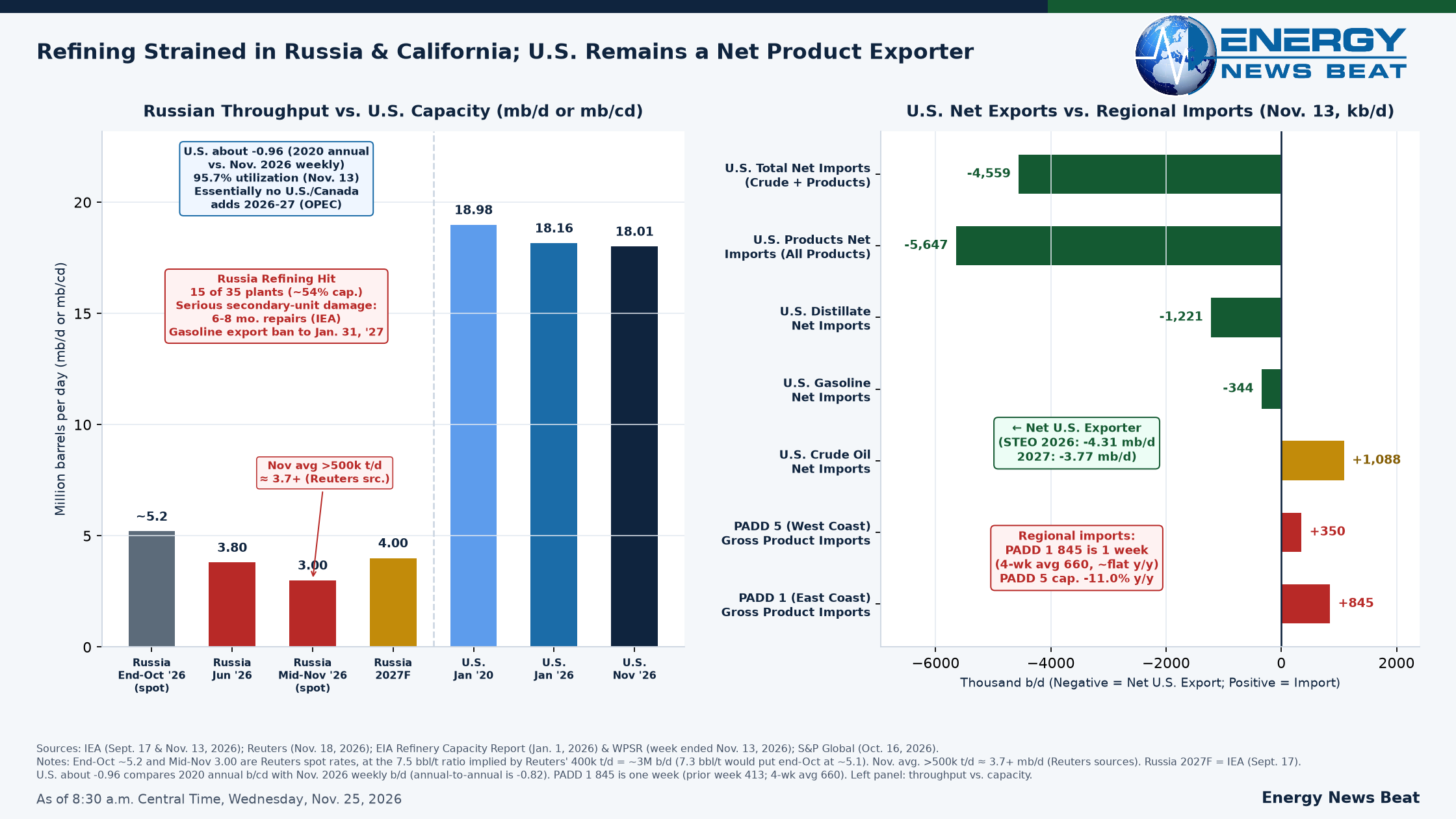
Reuters reported Nov. 18, citing two industry sources, that Ukrainian drones had disrupted or halted 15 of Russia’s 35 major refineries, and that plants hit since late October account for about 54% of primary capacity. Those sources put processing at about 400,000 metric tons a day, roughly 3 million b/d, down from more than 700,000 tons a day at the end of October, with November’s average above 500,000 tons a day.
Forecasters see a 2027 crude surplus
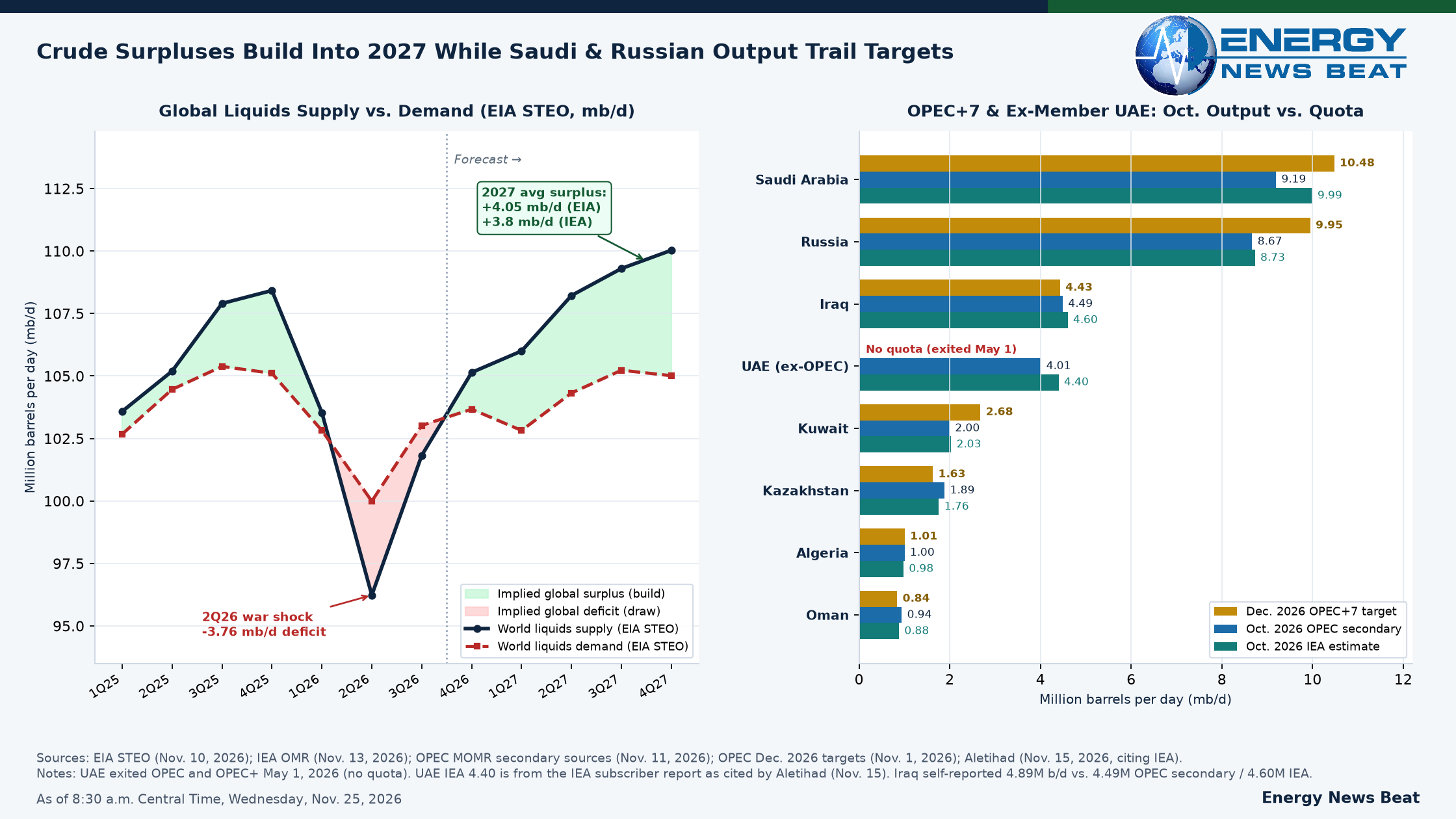
The IEA and EIA both project a 2027 surplus. The IEA’s Nov. 13 report said global supply is now running ahead of demand for the first time since the war began, and that observed inventories rose 52 million barrels in October. It puts 2027 supply at 108.1 million b/d against demand of 104.3 million b/d, a gap of about 3.8 million b/d by ENB’s arithmetic. EIA’s Nov. 10 outlook shows 2027 production of 108.40 against consumption of 104.35 million b/d, an implied surplus of about 4.05 million b/d. Rystad Energy, cited by Rigzone, sees about 5 million b/d. OPEC sees it differently, projecting 2027 demand of 108.3 million b/d, about 4 million b/d above the IEA and EIA, according to the International Energy Forum.
The IEA said on-land stocks are at their lowest since at least 2016, and that observed global stocks have fallen a cumulative 462 million barrels since the war began. Gulf shipping is still under threat, as ENB covered in Houthis Claim Ras Tanura Strike and Iraq Disputes OPEC+ Capacity; Brent Recovers After a Dip to $90.96
OPEC+ heads into Sunday with a split scorecard
OPEC+ ministers meet Sunday, Nov. 29, to set 2027 policy, and the 2 million b/d cut agreed in 2022 expires at year-end, according to Rystad via Rigzone. October figures, in Chart 1 and Appendix A, show a split scorecard: Saudi Arabia, Russia, and Kuwait produced well below their December targets, while Kazakhstan, Oman, and Iraq produced above theirs. Saudi Arabia’s gap partly reflects Gulf disruption; OPEC’s direct-communication figure was 10.563 million b/d, close to its 10.478 million b/d target, while secondary sources put it at 9.194 million b/d.
Iraq is disputing its capacity number. Reuters reported a preliminary consultants’ assessment near 4.9 million b/d; Bloomberg, as cited by Entelera, reported that Baghdad claims 5.2 million b/d; and OilPrice.com reported Iraqi officials pointing to about 6 million b/d. The UAE, which left OPEC and OPEC+ on May 1, produced 4.008 million b/d in October by OPEC’s count. The IEA’s subscriber report, cited by Aletihad, put UAE output at about 4.40 million b/d. The IEA put effective spare capacity across the group at only 0.45 million b/d in October.
America is pumping at a record
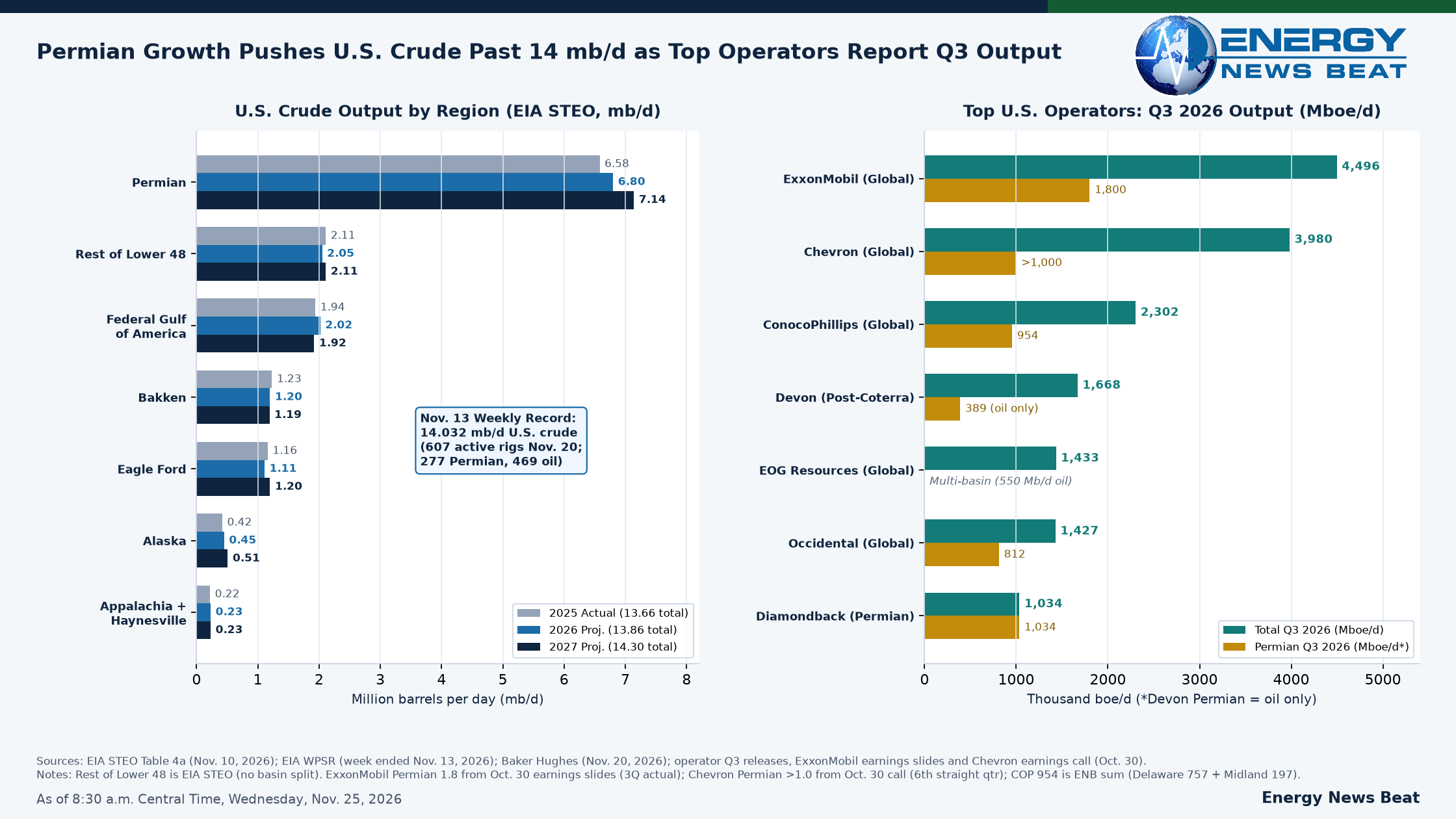
U.S. crude output reached 14.032 million b/d in the week ended Nov. 13, the fourth straight weekly record, EIA data show. EIA expects U.S. production to average 13.86 million b/d this year and 14.30 million b/d in 2027, with the Permian rising from 6.80 to 7.14 million b/d. Baker Hughes counted 607 active rigs on Nov. 20, including 469 oil rigs and 277 in the Permian. Operator figures are in Appendix C and Chart 2.
Why diesel has not followed crude down
The IEA wrote in September that minor damage to a crude distillation unit can typically be repaired in one to two weeks, but repairs to more complex secondary units such as hydrocrackers and catalytic crackers, particularly those that suffered serious damage, can take six to eight months on average, and the IEA said Western sanctions limiting access to some equipment suppliers are lengthening replacement times. It reported the Moscow refinery offline until early 2027, with runs of about 4.0 million b/d through 2027. The IEA also pointed to the Middle East: Gulf exports of refined products and LPG remain at roughly half of pre-war levels.
Russia’s gasoline export ban, covering producers and non-producers, and diesel curbs for non-producers, run through Jan. 31, 2027, Interfax reported. Deputy Prime Minister Alexander Novak said Wednesday that a December decision will come on extending the gasoline ban, RIA Novosti reported. EIA spot data compiled by The Vault Report show the New York Harbor diesel crack at $82.38 a barrel on Nov. 17, versus $8.25 for gasoline, and a 3-2-1 crack of $32.96, down from a September peak of $81.86. The IEA’s November report said “the severe tightness in product supply, especially for diesel, remains the overriding concern of the broader market and consumers.”
OPEC’s World Oil Outlook expects 1.1 million b/d of global distillation additions this year and 0.6 million b/d next year, with essentially no additions in the U.S. and Canada. U.S. refiners ran at 95.7% of capacity in the week ended Nov. 13, and EIA’s November outlook lists “the need to undertake maintenance that was deferred in 2026” as a source of uncertainty for its forecast.
Is America dependent on foreign fuel? Nationally no; regionally, the coasts rely on imports
In the week ended Nov. 13, the United States exported 7.376 million b/d of refined products and imported 1.729 million b/d, a net of about 5.6 million b/d, including about 1.2 million b/d of net distillate exports. Counting crude and products together, net exports were 4.559 million b/d. EIA projects net petroleum exports of 4.31 million b/d this year and 3.77 million b/d in 2027.
U.S. refining capacity is shrinking. EIA counted 18.976 million barrels per calendar day on Jan. 1, 2020, 18.160 million on Jan. 1, 2026, and 18.012 million b/d weekly in the week ended Nov. 13. Three closures since early 2025 account for about 547,500 b/d: LyondellBasell Houston, Phillips 66 Los Angeles, and Valero Benicia. West Coast (PADD 5) capacity was 2.277 million b/d that week, down 11% from a year earlier, and EIA notes there is relatively little pipeline capacity from the Gulf Coast.
S&P Global reported that West Coast gasoline imports reached 19.07 million barrels this year through its reporting period, up 54.5% from 2025, from 15 countries. EIA’s weekly data are more mixed: PADD 5 product imports averaged 212,000 b/d over the four weeks to Nov. 13, about half the year-earlier pace. California diesel averaged $7.436 a gallon on Nov. 23, versus $5.294 on the Gulf Coast. PADD 1, with seven operating refineries, imported 845,000 b/d of products in the week ended Nov. 13, about double the prior week; its four-week average of 660,000 b/d was about level with a year earlier. Nationally the U.S. remains a large net fuel exporter; the coasts still rely on imports and tankers for a share of supply.
Timeline
- 28, 2026: U.S. and Israeli strikes on Iran begin the war that disrupts Gulf shipping.
- Early 2026: Valero Benicia (145,000 b/d) stops refining. EIA removed it from monthly capacity estimates in March.
- May 1, 2026: The UAE exits OPEC and OPEC+.
- June 2026: IEA reports Russian refinery runs near 3.8 million b/d.
- July 30, 2026: Russia extends gasoline and diesel export restrictions through Jan. 31, 2027.
- September 2026: New York Harbor 3-2-1 crack peaks at $81.86; IEA details six-to-eight-month repair times for seriously damaged Russian secondary units.
- 8, 2026: The IEA’s Dated Brent benchmark hits $136.
- October 2026: IEA says global observed stocks rise 52 million barrels.
- 10 to 13, 2026: EIA and IEA monthly reports imply a 2027 surplus; OPEC’s report projects much higher demand.
- Week ended Nov. 13, 2026:S. crude output hits a record 14.032 million b/d; refinery utilization 95.7%.
- 18, 2026: Reuters reports 15 of 35 major Russian refineries disrupted or halted.
- 20, 2026: Baker Hughes counts 607 U.S. rigs, 277 in the Permian.
- 25, 2026: Bloomberg reports Russian crude exports at a post-2022 annual high; Reuters puts Brent futures at $90.96 at 4:35 a.m. CT; Novak says a gasoline export ban decision will come in December.
- 29, 2026: OPEC+ ministerial meeting on 2027 policy.
- 31, 2027: Russia’s current fuel export restrictions are scheduled to expire.
Consumer View
For most families, the crude surplus is the good news and diesel is the catch. Gasoline at $3.587 on AAA’s Wednesday average is much closer to normal than diesel, because gasoline margins have fallen to about $8 a barrel while diesel margins remain above $80. Diesel moves through groceries and freight, and California diesel is running more than $2 a gallon above the Gulf Coast.
Investor View
This section is information, not investment advice. Crude supply growth from Russia, the Permian, and the UAE lines up with IEA and EIA forecasts of a 2027 surplus. Product-side signals include diesel cracks above $80 a barrel, 95.7% utilization in the week ended Nov. 13, deferred maintenance, essentially no new U.S. or Canadian capacity in OPEC’s outlook, seriously damaged Russian secondary units that can take six to eight months to repair, and Gulf product exports at roughly half of pre-war levels.
Caveats
Bloomberg’s Nov. 25 article is behind a paywall; this piece uses its published figures and one short quote. The Nov. 17 Bloomberg findings come from a secondary summary. Reuters’ Russian refinery figures rely on unnamed industry sources. Surplus estimates differ by agency, and OPEC does not project a 2027 surplus. Chart 3 mixes Russian spot rates with monthly or annual figures; the end-October bar is an ENB conversion at the 7.5 barrels-per-ton ratio implied by Reuters’ 400,000 t/d figure. Annual and weekly EIA capacity figures use slightly different measures. U.S. weekly figures are for the week ended Nov. 13; EIA’s report for the week ended Nov. 20 was not yet out at this writing.
Stu’s Take
This is the split I have been talking about. The crude side of the market is healing: Russia is exporting at a post-2022 high, the Permian keeps setting records, and the IEA and EIA both see a surplus next year. But you cannot put crude oil in a truck. Iran is trying that, and has tens of thousands of tanker trucks trying to get cash flow and going over land to China. This is like trying to fix a hole in the Hoover Dam with a Band Aid. Russia’s damaged refinery units take months to fix, we have closed about half a million barrels a day of refining since early 2025, and OPEC’s outlook shows no new U.S. or Canadian refining capacity through 2027. Nationally we are still a big fuel exporter, so let’s not overstate it. But California and the East Coast are leaning harder on imports, and that is a policy choice worth a real debate.
Sources
- Bloomberg, Julian Lee, “Russia’s Elevated Oil Exports Add to Global Supply Surplus,” Nov. 25, 2026 (paywalled; notes and short quotes only): https://www.bloomberg.com/news/articles/2026-11-25/russia-s-elevated-oil-exports-add-to-global-supply-surplus
- HeadlinesBriefing summary of Bloomberg, Nov. 17, 2026: https://headlinesbriefing.com/market/bloomberg-markets/russias-oil-exports-surge-as-drones-hit-refineries-507b9dd1
- Reuters via The Jerusalem Post, Russian refinery disruptions, Nov. 18, 2026: https://www.jpost.com/international/internationalrussia-ukraine-war/article-915337
- IEA, Oil Market Report, Nov. 13, 2026: https://www.iea.org/reports/oil-market-report-november-2026
- IEA commentary on Russian refining, Sept. 17, 2026: https://www.iea.org/commentaries/russian-refining-sector-struggles-amid-intensifying-ukrainian-attacks
- EIA, Short-Term Energy Outlook, Nov. 10, 2026: https://www.eia.gov/outlooks/steo/ ; https://www.eia.gov/outlooks/steo/report/global_oil.php ; https://www.eia.gov/outlooks/steo/tables/pdf/4atab.pdf ; deferred-maintenance language: https://www.eia.gov/outlooks/steo/report/petro_prod.php
- OPEC Monthly Oil Market Report, Nov. 11, 2026: https://publications.opec.org/momr/chapter/163/3055
- OPEC, December 2026 required production, Nov. 1, 2026: https://www.opec.org/pr-detail/620-1-november-2026.html
- IEF comparative analysis, November 2026: https://www.ief.org/_resources/files/news/comparative-analysis-of-monthly-reports-on-the-oil-market/november-2026/ief-comparative-analysis-11-2026.pdf
- Rigzone (Rystad Energy), Nov. 25, 2026: https://www.rigzone.com/news/opec_will_see_one_of_most_complicated_meetings_in_years-25-nov-2026-185164-article/
- Reuters via Oil Monster, Iraq capacity, Nov. 25, 2026: https://www.oilmonster.com/article/iraq-challenges-opec-oil-capacity-estimate-ahead-of-2027/8832
- Entelera, Nov. 25, 2026: https://entelera.com/opec-quotas-iraq-capacity-basrah-2027/
- OilPrice.com, Iraq capacity, Nov. 24, 2026: https://oilprice.com/Latest-Energy-News/World-News/Iraq-Refuses-to-Accept-OPEC-Assessment-of-its-Production-Capacity.html
- OilPrice.com, U.S. output and drilling, Nov. 2026: https://oilprice.com/Energy/Energy-General/US-Oil-Drillers-Pick-Up-the-Pace-Just-as-Oil-Prices-Fall.html
- EIA Weekly Petroleum Status Report, week ended Nov. 13, 2026: https://www.eia.gov/petroleum/supply/weekly/
- Baker Hughes rig count via Oil & Gas 360, Nov. 20, 2026: https://www.oilandgas360.com/baker-hughes-rig-count-11-20-2/
- EIA Refinery Capacity Report, Jan. 1, 2026: https://www.eia.gov/petroleum/refinerycapacity/refcap26.pdf
- EIA historical operable capacity: https://www.eia.gov/dnav/pet/hist/LeafHandler.ashx?f=A&n=PET&s=8_NA_8D0_NUS_4
- EIA Today in Energy on U.S. refinery closures: https://www.eia.gov/TODAYINENERGY/detail.php?id=67807
- S&P Global, West Coast gasoline imports, Oct. 16, 2026: https://www.spglobal.com/energy/en/news-research/latest-news/refined-products/101626-west-coast-gasoline-imports-hit-five-year-high-after-refineries-went-dark-cas
- OPEC World Oil Outlook 2026, refining chapter: https://publications.opec.org/woo/chapter/157/2945
- The Vault Report, EIA crack spread data, Nov. 17, 2026: https://thevaultreport.com/oil/crack-spread
- Interfax, Russian fuel export ban, July 30, 2026: https://interfax.com/newsroom/top-stories/118566/
- Russian Government, extension of producer fuel-export measures, Oct. 31, 2026: http://government.ru/en/dep_news/60326/
- RIA Novosti, Novak on gasoline export ban, Nov. 25, 2026: https://ria.ru/20261125/benzin-2133861060.html
- EIA Gasoline and Diesel Fuel Update, Nov. 23, 2026: https://www.eia.gov/petroleum/gasdiesel/
- AAA gas prices, Nov. 25, 2026: https://gasprices.aaa.com/
- Reuters via Euronext, Brent at $90.96 at 1035 GMT, Nov. 25, 2026: https://live.euronext.com/en/financial-news/oil-edges-down-supply-glut-prospect-offsets-middle-east-disruption-fears
- CNBC delayed Brent quote, Nov. 25, 2026: https://www.cnbc.com/quotes/@LCO.1
- Operator releases and filings: ExxonMobil release https://investor.exxonmobil.com/company-information/press-releases/detail/1213/exxonmobil-announces-third-quarter-2026-results ; ExxonMobil 3Q 2026 earnings presentation (Permian 1.8 million boe/d), via IR calendar https://investor.exxonmobil.com/news-events/ir-calendar/detail/20261030-3q-2026-earnings-call ; Chevron release https://chevroncorp.gcs-web.com/news-releases/news-release-details/chevron-reports-third-quarter-2026-results ; Chevron Oct. 30 earnings call transcript (Permian above 1 million boe/d) https://chevroncorp.gcs-web.com/static-files/000e7741-422d-4e9f-854e-07c4ccee0ffb ; ConocoPhillips https://www.conocophillips.com/news-media/story/conocophillips-announces-third-quarter-2026-results-and-increases-quarterly-ordinary-dividend-by-11/ ; Devon https://www.sec.gov/Archives/edgar/data/1090012/000119312526449884/d120646dex991.htm ; EOG https://investors.eogresources.com/2026-11-05-EOG-Resources-Reports-Third-Quarter-2026-Results-and-Raises-Regular-Dividend-8 ; Occidental https://www.sec.gov/Archives/edgar/data/797468/000162828026072193/oxyex9919-30x26earningsrel.htm ; Diamondback https://www.diamondbackenergy.com/news-releases/news-release-details/diamondback-energy-inc-announces-third-quarter-2026-financial
- Aletihad, UAE October output of about 4.4 million b/d from the IEA subscriber report, Nov. 15, 2026: https://en.aletihad.ae/news/business/4706059/uae-oil-output-steady-at-4-4-million-bpd-in-october-as-gulf
- ENB, Houthis Claim Ras Tanura Strike and Iraq Disputes OPEC+ Capacity; Brent Recovers After a Dip to $90.96, Nov. 25, 2026: http://energyinvestingbeat.com/crude-oil/houthis-claim-ras-tanura-strike-and-iraq-disputes-opec-capacity-brent-recovers-after-a-dip-to-90-96/
Key Excerpts
- Bloomberg, Nov. 25 (paywalled): Russian crude flows “are helping to stoke a supply surplus that’s set to define the oil market next year and possibly beyond.”
- IEA, Nov. 13: “The oil market is showing tentative signs of rebalancing, with global oil supplies surpassing demand for the first time since the outbreak of the war in Iran.”
- IEA, Nov. 13: “the severe tightness in product supply, especially for diesel, remains the overriding concern of the broader market and consumers.”
- IEA, Nov. 13: “Global oil demand continues to be weighed down by ongoing disruptions to exports of refined products and LPG from the Gulf, remaining at roughly half of pre-war levels.”
- Reuters via Euronext, Nov. 25: “Brent crude futures declined 44 cents, or 0.5%, to $90.96 a barrel at 1035 GMT.”
- RIA Novosti, Nov. 25, quoting Novak (ENB translation): the ban is extended to the end of January, and “in December we will make a decision depending on the balance forecast.”
Appendix A: OPEC+ Members, October 2026 Output
Million b/d. OPEC secondary sources from the Nov. 11 MOMR; IEA estimates from the Nov. 13 OMR, except the UAE figure, which is from the IEA subscriber report as cited by Aletihad (Nov. 15). Targets marked are OPEC’s December 2026 required production (Nov. 1 statement); targets marked * are the IEA’s implied October targets.
| Member | OPEC secondary | IEA | Dec. target | Note |
| Saudi Arabia | 9.194 | 9.99 | 10.478* | Self-reported 10.563 |
| Russia | 8.668 | 8.73 | 9.949* | Below target |
| Iraq | 4.491 | 4.60 | 4.431* | Self-reported 4.888; capacity disputed |
| Kuwait | 1.998 | 2.03 | 2.676* | Below target |
| Kazakhstan | 1.887 | 1.76 | 1.628* | Above target |
| Algeria | 1.002 | 0.98 | 1.007* | Near target |
| Oman | 0.941 | 0.88 | 0.841* | Above target |
| UAE (exited May 1) | 4.008 | 4.40 | None | No quota; IEA 4.40 via Aletihad |
| Nigeria | 1.542 | 1.44 | 1.50** | OPEC member |
| Iran (exempt) | 1.914 | 1.86 | Exempt | War-affected |
| Libya (exempt) | 1.333 | 1.28 | Exempt | |
| Venezuela (exempt) | 1.158 | 1.14 | Exempt | |
| Mexico | 1.441 | 1.37 | n/a | Excluded from compliance (IEA) |
| Azerbaijan | 0.447 | 0.43 | 0.55** | Non-OPEC DoC |
| Malaysia | 0.302 | n/a | n/a | IEA groups in Others (0.72) |
| Congo | 0.270 | 0.26 | 0.28** | OPEC member |
| Gabon | 0.212 | 0.22 | 0.18** | OPEC member |
| South Sudan | 0.136 | n/a | n/a | IEA groups in Others (0.72) |
| Bahrain | 0.135 | n/a | n/a | IEA groups in Others (0.72) |
| Brunei | 0.088 | n/a | n/a | IEA groups in Others (0.72) |
| Equatorial Guinea | 0.044 | 0.03 | 0.07** | OPEC member |
| Sudan | 0.022 | n/a | n/a | IEA groups in Others (0.72) |
| OPEC+ total ex-UAE | 37.222 | 37.72 | n/a | IEA effective spare capacity 0.45 |
Appendix B: U.S. Crude Production by Region (EIA STEO, Nov. 10)
| Region | 2025 | 2026F | 2027F |
| Permian | 6.58 | 6.80 | 7.14 |
| Federal Gulf of America | 1.94 | 2.02 | 1.92 |
| Bakken | 1.23 | 1.20 | 1.19 |
| Eagle Ford | 1.16 | 1.11 | 1.20 |
| Rest of Lower 48 | 2.11 | 2.05 | 2.11 |
| Alaska | 0.42 | 0.45 | 0.51 |
| Appalachia | 0.19 | 0.20 | 0.20 |
| Haynesville | 0.03 | 0.03 | 0.03 |
| U.S. total | 13.66 | 13.86 | 14.30 |
Million b/d. Rows may not sum due to rounding. Weekly U.S. output was 14.032 million b/d in the week ended Nov. 13. Baker Hughes, Nov. 20: 607 rigs, 469 oil, 128 gas, 277 Permian.
Appendix C: Largest U.S. Operators, Third Quarter 2026
The largest operators reported third-quarter output in their October and November filings and, where noted, on earnings calls or slides. ExxonMobil produced 4.496 million barrels of oil equivalent a day worldwide. Its Oct. 30 earnings slides listed Permian production of 1.8 million boe/d in the third quarter, matching its full-year guidance. Chevron produced 3.980 million boe/d; on its Oct. 30 earnings call, the company said the Permian recorded its sixth consecutive quarter above 1 million boe/d. ConocoPhillips reported 2,302 kboe/d globally; the 954,000 boe/d Permian figure used here and in Chart 2 is an ENB sum of 757,000 boe/d from the Delaware Basin and 197,000 boe/d from the Midland Basin. Occidental reported 812,000 boe/d from the Permian, and Diamondback 525,000 b/d of oil. Devon, after its Coterra combination, guided to 1% to 3% oil growth in 2027.
| Operator | Total output | Detail |
| ExxonMobil | 4,496 kboe/d (global) | Permian 1.8 million boe/d (Oct. 30 earnings slides, 3Q actual) |
| Chevron | 3,980 kboe/d (global) | Permian above 1 million boe/d (Oct. 30 earnings call); U.S. refining 1.09 million b/d |
| ConocoPhillips | 2,302 kboe/d (global) | Delaware 757 + Midland 197 = 954 kboe/d (ENB sum) |
| Devon | 1,668 kboe/d | Permian oil 389 kb/d; 2027 oil growth guidance 1% to 3% |
| EOG | 1,433 kboe/d | 550 kb/d oil |
| Occidental | 1,427 kboe/d (global) | Permian 812 kboe/d |
| Diamondback | 1,034 kboe/d | 525 kb/d oil, Permian |
Company third-quarter releases, SEC filings, ExxonMobil earnings slides, and the Chevron earnings call, Oct. 30 to Nov. 5, 2026.
Appendix D: U.S. Refining and Trade, Week Ended Nov. 13, 2026
| Measure | Value |
| Operable capacity, Jan. 1, 2020 (EIA annual) | 18.976 million b/cd |
| Operable capacity, Jan. 1, 2026 (EIA annual) | 18.160 million b/cd |
| Operable capacity, week ended Nov. 13 (EIA weekly) | 18.012 million b/d |
| Utilization, week ended Nov. 13 | 95.7% (PADD 3 97.1%, PADD 5 91.9%) |
| PADD 5 operable capacity | 2.277 million b/d, down 11.0% y/y |
| Product exports / imports | 7.376 / 1.729 million b/d |
| Net product exports | 5.647 million b/d |
| Distillate net exports | 1.221 million b/d |
| Net petroleum exports (crude plus products) | 4.559 million b/d |
| PADD 1 product imports, week ended Nov. 13 | 845 kb/d (prior week 413; 4-wk avg 660 vs. 667 a year earlier) |
| PADD 5 product imports, 4-wk avg | 212 kb/d (vs. 438 a year earlier) |
| Distillate stocks | 104.9 million barrels |
| NYH diesel / gasoline crack, Nov. 17 | $82.38 / $8.25 per barrel |
| Diesel retail, Nov. 23: U.S. / California / Gulf Coast | $5.695 / $7.436 / $5.294 per gallon |