

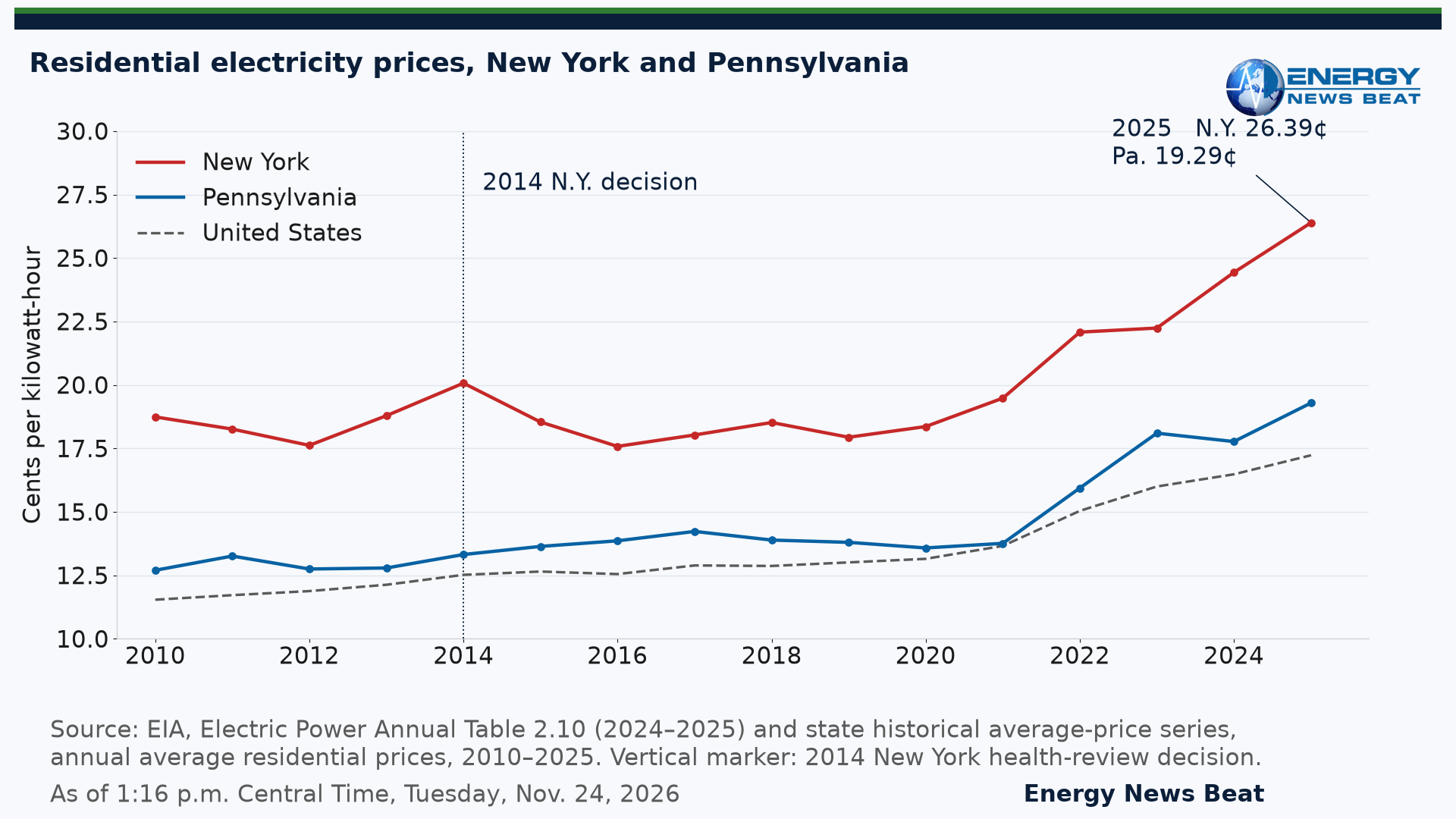
Pacific Legal Foundation sued for a Wayne County mineral owner, asking courts to set aside the Delaware River Basin Commission’s 2021 ban and to require just compensation; neither complaint states a dollar figure. New York’s ban still stands. EIA data show its electricity and natural-gas prices top Pennsylvania’s, a gap that already existed in 2014. The data alone do not prove the bans caused it.
A Wayne County woman who co-owns the mineral rights under her family’s farm is asking federal courts to make a choice landowners and regulators have argued over for years: pay up, or lift the ban. Pacific Legal Foundation said it filed a federal lawsuit on Nov. 23 for June Chesser, challenging the Delaware River Basin Commission’s 2021 high-volume fracturing ban as a taking without just compensation. Pacific Legal Foundation also filed a Court of Federal Claims case against the United States on Nov. 19, No. 1:26-cv-01808, seeking just compensation ‘in an amount to be determined at trial.’ The Scranton case is Chesser v. Delaware River Basin Commission, No. 3:26-cv-03417, assigned to Judge Julia K. Munley. Neither complaint states a dollar figure.
The suits land beside a New York ban that is still in force — and was tightened, not loosened, in 2024. Households in New York already pay higher prices than Pennsylvania households for electricity and natural gas. Their average monthly electricity bill is not higher, because Pennsylvania households use more power; their gas bills are. The data show that gap. They do not, by themselves, prove that the fracking bans caused it.
A new landowner case, after earlier challenges fell on standing
Chesser co-owns the mineral rights under her family’s farm in Damascus Township, Wayne County, Pennsylvania, inside the basin, in a county that borders Susquehanna County, where drilling is allowed. Marcellus Drilling News described the property as an 83-acre farm; she does not own the surface. Pacific Legal Foundation, representing her at no charge, says her parents leased the gas rights in 2009, deeded the minerals to Chesser and her sisters in 2010, and the lessee released the lease in 2013 after a de facto Commission moratorium.
The legal theory is a regulatory-takings claim, plus an argument about the 1961 compact. The firm says high-volume fracturing is the only commercially viable way to reach the gas, so the ban wipes out all economically viable use of the mineral estate and requires just compensation under the Fifth Amendment. It says the compact lets the Commission classify waters and set waste-treatment standards, not ban a lawful land use on private property. The firm’s case page says the ban “traps an estimated $40 billion in natural gas in the region underground,” a litigant estimate used since a 2021 lawsuit, which attributed it to the U.S. Geological Survey, not an independent resource assessment.
A de facto Commission pause took shape in 2009 and 2010. The Commission formally banned high-volume fracturing on Feb. 25, 2021, with all four basin states voting yes and the federal member abstaining. Wayne Land and Mineral Group’s 2016 lawsuit produced a 2018 Third Circuit remand, then was dismissed as moot on Feb. 3, 2025. A 2021 case led by Sens. Gene Yaw and Lisa Baker, Wayne County and others was dismissed for lack of standing; the Third Circuit affirmed that result on Sept. 16, 2022, and did not decide the merits. A House amendment to block enforcement failed on Sept. 3, 2025, 195–235.
New York’s ban is still in force, and last year’s energy moves were about pipelines
New York’s ban has not been reopened. After a multiyear review, the Department of Health recommended in December 2014 that the state not proceed with high-volume fracturing. The Department of Environmental Conservation issued a binding findings statement on June 29, 2015, officially prohibiting HVHF in New York. A statutory ban followed on April 3, 2020. On Dec. 21, 2024, Gov. Kathy Hochul signed a law extending the prohibition to carbon-dioxide fracturing. Pacific Legal Foundation’s parallel New York case, Woodward v. Lefton, No. 3:26-cv-00736, was filed April 16, 2026, for mineral owners of 164 acres near Sidney, in Delaware County. A motion to dismiss was fully briefed by Aug. 28, 2026; the plaintiffs asked for oral argument Sept. 10, and no ruling has been reported.
What changed in 2025 and 2026 was pipeline review, not the well ban. DEC approved a water-quality certification for Williams’ Northeast Supply Enhancement project on Nov. 7, 2025; Constitution Pipeline withdrew the same day. Those are fights over gas delivery into downstate New York, not over whether a well may be drilled in Wayne County or Delaware County, N.Y.
What the data show — and what they do not prove
The Energy Information Administration‘s annual figures show New York households paid an average 26.39 cents a kilowatt-hour for residential electricity in 2025, compared with 19.29 cents in Pennsylvania and 17.23 cents for the United States. That 7.10-cent gap was already 6.75 cents in 2014, when New York’s price was 20.07 cents and Pennsylvania’s was 13.32 cents. From 2014 to 2025, Pennsylvania’s price rose faster in percentage terms — about 45 percent — than New York’s, about 31 percent. At the same 600 kilowatt-hours a month, the 2025 averages imply a difference of roughly $43. Actual bills differ because usage differs: EIA’s 2024 average monthly residential bill was $139.53 in New York and $145.17 in Pennsylvania, where households used about 817 kilowatt-hours a month against New York’s 571. The rate gap is real; it is not a finding that the frack ban caused it.
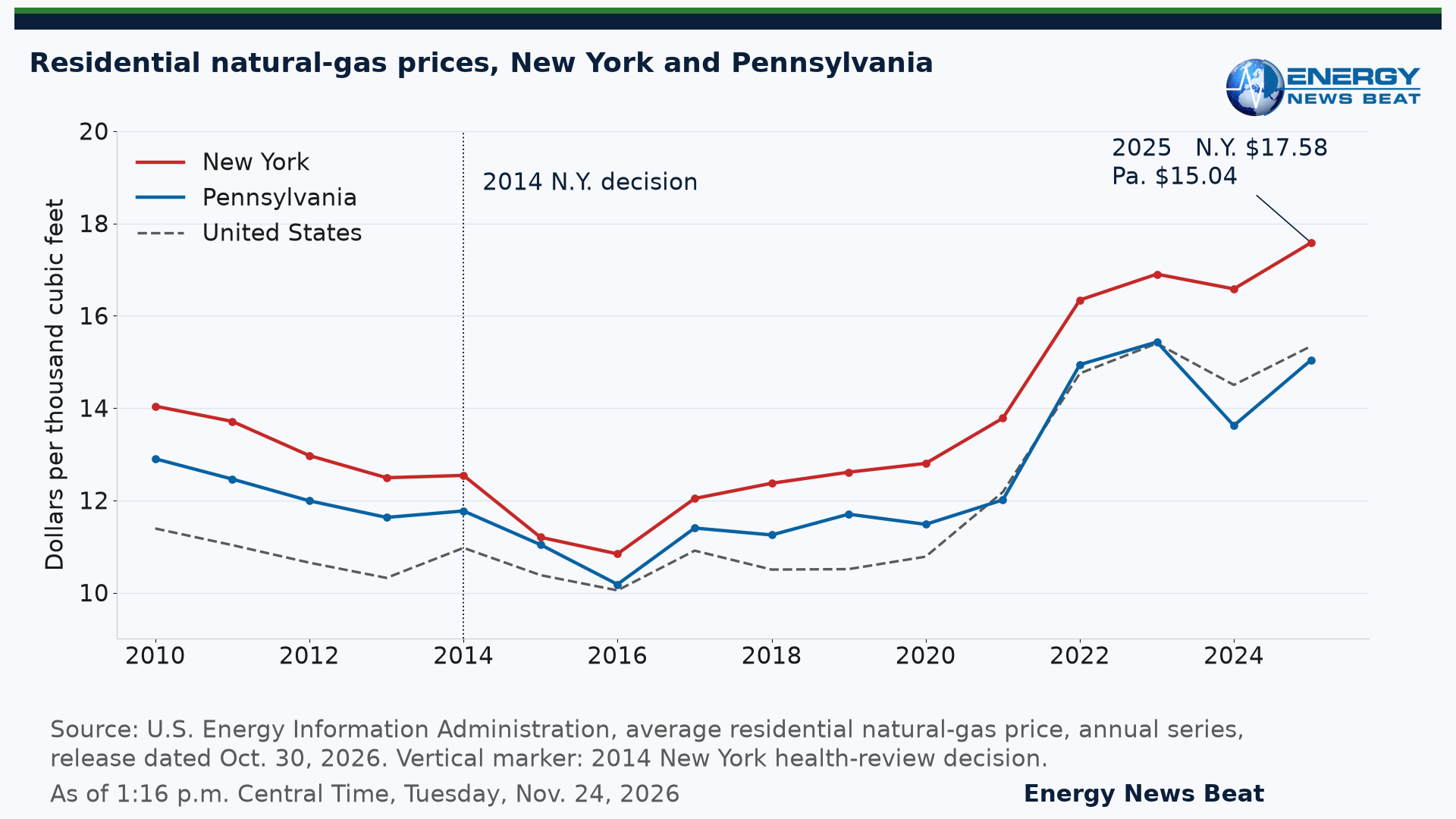
Annual residential gas prices tell a related story. New York averaged $17.58 per thousand cubic feet in 2025, against $15.04 in Pennsylvania and $15.34 for the United States. That gap was $0.77 in 2014 and $2.54 in 2025. During Winter Storm Fern, Natural Gas Intelligence reported that the Algonquin Citygate hub in Boston averaged $121.560 per million Btu on Jan. 26, 2026, and New York City’s Transco Zone 6 NY hub a record $142.715 — one-day cash prints, not household tariffs. NYISO said it then ran oil-fired and dual-fuel generation and demand response for six consecutive days.
Climate Act costs belong in the bill discussion, kept apart from the well ban. In a Nov. 19 report, the Department of Public Service said those costs amounted to 4.7 percent to 9.9 percent of typical residential electric bills in 2025, depending on the utility, and 0.3 percent to 2.0 percent of residential gas bills. Utilities recovered more than $2.3 billion from electric bills and $152 million from gas bills for programs supporting the Climate Leadership and Community Protection Act.
Pennsylvania’s Public Utility Commission said it distributed $243,877,400 in Act 13 impact fees for the 2025 reporting year, bringing the cumulative total since 2012 to more than $3.12 billion. Sen. Lisa Baker and Rep. Jonathan Fritz said Susquehanna County and its municipalities were allocated more than $20.7 million of that year’s distribution; the county’s own $7.5 million was the largest county allocation in the state. Wayne County, inside the ban, has not seen comparable development, and New York has no counterpart fee.
Drinking water, transmission, and the limits of a well in Wayne County
At the 2021 vote, Delaware Gov. John Carney, then Commission chair, said the decision would protect “the more than 13 million people who rely upon the Delaware River Basin’s waters for their drinking water,” according to WHYY. The Commission cited risks of spills and of salts, metals, radioactive materials and chemicals migrating. Pennsylvania’s Department of Environmental Protection publishes determination letters in cases where oil and gas operations were found to have affected water supplies. A draft 2019 University of Delaware white paper estimated a much smaller annual extraction value in the watershed than the $40 billion in-ground figure used by litigants, and a much larger annual value for drinking water, forests and recreation; the methods are not apples-to-apples.
New York’s grid problem is partly about fuel delivery, aging wires and substations, and rising demand — not only about whether the Southern Tier is fracked. NYISO’s winter concern is gas availability to power plants in extreme cold. Downstate constraints on Algonquin, Iroquois and Transco, and the fight over the Williams and Constitution projects, are the more direct reliability link. Jumping from “Wayne County cannot drill” to “that is why a Brooklyn bill is high” would be over-claiming.
Consumer and Investor Views
Not investment advice. The new lawsuits are early. No public compensation figure has been stated for the Chesser minerals, and no court has ruled. The data show that New York residential electricity and annual gas prices are higher than Pennsylvania’s, and that the electricity gap was already wide in 2014. They do not prove that lifting either ban would lower your bill, or that the bans caused the difference. Climate Act charges are a separate line of costs. None of this is a recommendation to buy or sell any security, mineral interest or energy contract.
Timeline
A short path from the first basin restrictions and New York’s review to this week’s filings and the latest price data.
2009–2010. The Delaware River Basin Commission required prior approval for shale-gas extraction in special-protection waters, then extended that review to exploratory wells — the de facto moratorium.
Dec. 17, 2014, and June 29, 2015. New York’s health commissioner recommended that the state not proceed with high-volume fracturing. DEC’s findings statement officially prohibited it.
April 3, 2020, and Dec. 21, 2024. New York enacted a statutory high-volume fracturing ban, then extended the prohibition to carbon-dioxide fracturing.
Feb. 25, 2021, and Dec. 7, 2022. The Commission formally banned high-volume fracturing in the basin, with all four states voting yes and the federal member abstaining. Import, export and wastewater rules followed, effective March 6, 2023.
Sept. 16, 2022, and Feb. 3, 2025. The Third Circuit affirmed dismissal of the Yaw lawsuit for lack of standing, without deciding the merits. Wayne Land and Mineral Group’s case was later dismissed as moot.
April 16, 2026. Pacific Legal Foundation filed Woodward v. Lefton in the Northern District of New York, challenging the statewide ban. A motion to dismiss was fully briefed by Aug. 28, 2026, and the plaintiffs asked for oral argument Sept. 10; no ruling has been reported.
Nov. 19–23, 2026. Pacific Legal Foundation filed a Court of Federal Claims case, No. 1:26-cv-01808, on Nov. 19. The Middle District of Pennsylvania case, 3:26-cv-03417, was filed Nov. 23.
Caveats
The Court of Federal Claims case is No. 1:26-cv-01808, filed Nov. 19, per the stamped complaint Pacific Legal Foundation posted; Marcellus Drilling News, which is paywalled after the lede, also reported it. Neither complaint states a dollar figure; the claims-court complaint seeks compensation ‘in an amount to be determined at trial.’ The $40 billion “trapped gas” figure is a litigant estimate, not an independent resource assessment. The 83-acre farm size is from Marcellus Drilling News. The official 2021 phrasing for basin drinking-water users is “more than 13 million.” Climate Act bill shares are DPS figures for New York’s climate statute, not effects of the fracking bans. This article does not claim that the bans caused New York’s higher utility prices, and it is not investment advice.
Stu’s Take
Pacific Legal Foundation filed a federal lawsuit on Nov. 23 for June Chesser, a Wayne County mineral co-owner, asking a court to set aside the Delaware River Basin Commission’s 2021 fracking ban or require just compensation. The Scranton case is 3:26-cv-03417, before Judge Julia K. Munley. A companion Court of Federal Claims complaint, No. 1:26-cv-01808, was filed Nov. 19. Neither complaint states a dollar figure; the claims-court complaint seeks compensation ‘in an amount to be determined at trial.’ The “$40 billion” trapped-gas figure is a litigant estimate. New York’s ban is still in force and was tightened in 2024. EIA data show New York residential electricity averaged 26.39 cents a kilowatt-hour in 2025, versus 19.29 cents in Pennsylvania; that gap was already 20.07 cents versus 13.32 cents in 2014. In 2025, annual residential gas averaged $17.58 per thousand cubic feet in New York and $15.04 in Pennsylvania. The data show the gap; they do not, by themselves, prove the bans caused it.
Sources
Links, what each source was used for, and the time it was accessed, in Central Time, on Tuesday, Nov. 24, 2026, unless a later stamp is noted.
- Marcellus Drilling News, “Pay Up or Lift the Ban: Two New Lawsuits Target DRBC Frack Ban,” Nov. 24, 2026. Starting point; used for the lede and the 83-acre farm description. It also reported the Nov. 19 Court of Federal Claims filing, which is documented from Pacific Legal Foundation’s stamped complaint. The remainder of the MDN article is paywalled and was not read. Accessed 12:20 p.m. CT. https://marcellusdrilling.com/2026/11/pay-up-or-lift-the-ban-two-new-lawsuits-target-drbc-frack-ban/
- Pacific Legal Foundation press release, “Dairy farmer’s daughter sues to develop the energy beneath her family’s farm,” Nov. 23, 2026, Scranton. Used for the district-court filing, June Chesser, the Fifth Amendment and compact-authority theories, and the family lease history. Counsel of record is taken from the stamped complaints, not this release. Accessed 12:20 p.m. CT. https://pacificlegal.org/press-release/dairy-farmers-daughter-sues-to-develop-the-energy-beneath-her-familys-farm/
- Pacific Legal Foundation, June Chesser v. Delaware River Basin Commission case page. Used for the “estimated $40 billion” trapped-gas wording, the Chesser quotation, and the Susquehanna County contrast. Accessed 12:20 p.m. CT. https://pacificlegal.org/case/chesser-drbc-fracking/
- Pacific Legal Foundation, stamped complaint, Chesser v. Delaware River Basin Commission, No. 3:26-cv-03417, U.S. District Court for the Middle District of Pennsylvania, Judge Julia K. Munley, filed Nov. 23, 2026. Used for the caption, case number, filing date, and the prayer for just compensation. Accessed 12:20 p.m. CT. https://pacificlegal.org/wp-content/uploads/2026/11/Chesser-v-DRBC_Complaint_11.23.2026-1.pdf
- Pacific Legal Foundation, stamped complaint, Chesser v. United States, No. 1:26-cv-01808 (26-1808 L), U.S. Court of Federal Claims, filed Nov. 19, 2026. Used for the docket number, filing date, and the request for just compensation “in an amount to be determined at trial.” Accessed 12:20 p.m. CT. https://pacificlegal.org/wp-content/uploads/2026/11/Chesser-v-US_Complaint_11.19.2026.pdf
- WHYY, “Delaware River Basin Commission votes to ban fracking in the watershed,” Feb. 25, 2021. Used for the formal ban vote, the four-state yes and federal abstention, and Gov. John Carney’s “more than 13 million” drinking-water phrasing. Accessed 12:20 p.m. CT. https://whyy.org/articles/delaware-river-basin-commission-votes-to-ban-fracking-in-the-watershed/
- Delaware River Basin Commission, Resolution No. 2022-04, adopted Dec. 7, 2022, effective March 6, 2023, on water imports and exports and HVHF-wastewater discharge. Accessed 12:20 p.m. CT. https://www.nj.gov/drbc/library/documents/Res2022-04_finalrule_import-export-hvhf-discharge.pdf
- Third Circuit, Wayne Land & Mineral Group LLC v. DRBC, No. 17-1800, July 3, 2018, official PDF. Used for the remand holding that “project” in the compact is ambiguous. Accessed 12:20 p.m. CT. https://www2.ca3.uscourts.gov/opinarch/171800p.pdf
- U.S. District Court for the Middle District of Pennsylvania, Wayne Land & Mineral Group LLC v. DRBC, No. 3:16-cv-00897, memorandum opinion dismissing the case as moot, Feb. 3, 2025 (Doc. 231, Judge Mariani), via Justia. Accessed 12:20 p.m. CT. https://law.justia.com/cases/federal/district-courts/pennsylvania/pamdce/3:2016cv00897/107350/231/
- Third Circuit, Yaw v. DRBC, No. 21-2315, 49 F.4th 302, Sept. 16, 2022. Used for the standing dismissal, affirmed without a merits ruling on the ban. Accessed 12:20 p.m. CT. https://law.justia.com/cases/federal/appellate-courts/ca3/21-2315/21-2315-2022-09-16.html
- Yaw v. DRBC complaint, filed Jan. 11, 2021, via Courthouse News. An early source of the $40 billion Pennsylvania-basin gas-value estimate later repeated by litigants and industry. Accessed 12:20 p.m. CT. https://www.courthousenews.com/wp-content/uploads/2021/02/DRBC-suit.pdf
- League of Conservation Voters scorecard summarizing House roll call 227, Sept. 3, 2025, on the Perry amendment to H.R. 4553, rejected 195–235. Accessed 12:20 p.m. CT. https://www.lcv.org/roll-call-vote/blocking-the-delaware-river-basin-fracking-ban-2/
- NYSDEC, “High-Volume Hydraulic Fracturing In NYS.” Used for the Dec. 17, 2014 Department of Health review and the June 29, 2015 SEQR Findings Statement that officially prohibited HVHF in New York. Accessed 12:20 p.m. CT. https://dec.ny.gov/environmental-protection/oil-gas/high-volume-hydraulic-fracturing
- Food & Water Watch, contemporaneous statement dated Dec. 22, 2024, on Gov. Kathy Hochul signing A.8866/S.8357, Chapter 626 of 2024, extending the permit ban to carbon-dioxide fracturing. Accessed 12:20 p.m. CT. https://www.foodandwaterwatch.org/press/2024/12/22/legislators-environmental-health-leaders-applaud-gov-hochul-for-signing-the-co2-fracking-ban-bill/
- Pacific Legal Foundation, Woodward v. Lefton case page, and Justia docket No. 3:26-cv-00736, Northern District of New York, filed April 16, 2026. Used for the 164-acre Sidney mineral estate; the motion to dismiss was fully briefed by Aug. 28, 2026, and the plaintiffs asked for oral argument Sept. 10. Accessed 12:20 p.m. CT. https://pacificlegal.org/case/woodward-new-york-fracking-ban/
- Justia docket, Woodward v. Lefton, No. 3:26-cv-00736, Northern District of New York. Used for the Aug. 28, 2026, reply on the motion to dismiss and the Sept. 10 request for oral argument. Accessed 12:20 p.m. CT. https://dockets.justia.com/docket/new-york/nyndce/3:2026cv00736/153539
- NYSDEC statement, Nov. 7, 2025, on the water-quality certification for the Northeast Supply Enhancement project and Constitution Pipeline’s withdrawal the same day. Accessed 12:20 p.m. CT. https://dec.ny.gov/news/press-releases/2025/11/dec-statement-on-water-quality-certification-for-proposed-northeast-supply-enhancement-pipeline-project
- NYISO press release, Nov. 12, 2026, winter readiness assessment: 29,464 MW available against a 24,620 MW peak forecast, last winter’s 24,317 MW peak, the 25,738 MW all-time winter peak, and six consecutive days of oil-fired and dual-fuel generation and demand response after Winter Storm Fern. Accessed 12:20 p.m. CT. https://www.nyiso.com/-/press-release-nyiso-winter-readiness-assessment-finds-adequate-capacity-but-highlights-fuel-availability-risks
- U.S. Energy Information Administration, Electric Power Annual Table 2.10, annual average residential prices for 2024 and 2025, used for Chart 1 and the 2025 New York, Pennsylvania and U.S. comparisons. Accessed 12:20 p.m. CT. https://www.eia.gov/electricity/annual/xls/epa_02_10.xlsx
- U.S. Energy Information Administration, state historical average retail price of electricity, avgprice_annual.xlsx, used for the 2014 New York (20.07 cents), Pennsylvania (13.32 cents) and U.S. (12.52 cents) residential figures and earlier Chart 1 years. Accessed 12:20 p.m. CT. https://www.eia.gov/electricity/data/state/avgprice_annual.xlsx
- U.S. Energy Information Administration, Electric Sales, Revenue, and Average Price Table 5A, Average Monthly Bill – Residential, 2024 (released Oct. 7, 2025). Used for New York’s $139.53 average monthly bill (571 kWh) and Pennsylvania’s $145.17 (817 kWh). Accessed 12:20 p.m. CT. https://www.eia.gov/electricity/sales_revenue_price/xls/table_5A.xlsx
- U.S. Energy Information Administration, average residential natural-gas price, annual series, release dated Oct. 30, 2026, used for Chart 2 and the 2014 and 2025 gas comparisons. Accessed 12:20 p.m. CT. https://www.eia.gov/dnav/ng/ng_pri_sum_a_EPG0_PRS_DMCF_A.htm
- U.S. Energy Information Administration, residential natural-gas consumption and number of residential consumers by state (https://www.eia.gov/dnav/ng/ng_cons_sum_a_EPG0_VRS_mmcf_a.htm; https://www.eia.gov/dnav/ng/ng_cons_num_a_EPG0_VN3_Count_a.htm). ENB calculation, 2024: about 86.7 Mcf per New York residential customer at $16.58 ≈ $1,440 a year, against 73.1 Mcf at $13.62 ≈ $1,000 in Pennsylvania.
- Natural Gas Intelligence, “January 2026 Arctic Blast Broke Natural Gas Price Records From Gulf Coast to Northeast,” Feb. 4, 2026. Used for the Algonquin Citygate hub in Boston, which averaged $121.560 per million Btu on Jan. 26, 2026, and New York City’s Transco Zone 6 NY hub, a record $142.715 the same day. Accessed 12:20 p.m. CT. https://naturalgasintel.com/news/january-2026-arctic-blast-broke-natural-gas-price-records-from-gulf-coast-to-northeast/
- New York Department of Public Service, third annual CLCPA report release, Nov. 19, 2026. Used for the 4.7–9.9 percent and 0.3–2.0 percent bill shares and the $2.3 billion and $152 million 2025 recoveries. Accessed 12:20 p.m. CT. https://dps.ny.gov/news/dps-releases-third-annual-report-detailing-progress-and-costs-toward-state-climate-mandates
- Pennsylvania Public Utility Commission, June 15, 2026, announcement of $243,877,400 in Act 13 impact fees for the 2025 reporting year and a cumulative total since 2012 of more than $3.12 billion. Accessed 12:20 p.m. CT. https://www.puc.pa.gov/press-release/2026/puc-announces-2438-million-in-natural-gas-impact-fees-for-pennsylvania-communities-06152026
- Sen. Lisa Baker and Rep. Jonathan Fritz, June 18, 2026, on Susquehanna County and its municipalities being allocated more than $20.7 million of the 2025-year impact-fee distribution; the county’s own $7.5 million was the largest county allocation in the state. Accessed 12:20 p.m. CT. https://www.senatorbaker.com/2026/06/18/baker-fritz-susquehanna-county-to-receive-nearly-21-million-in-natural-gas-impact-fee-revenue/
- University of Delaware Water Resources Center, G. J. Kauffman and A. R. Homsey, a draft June 2019 white paper on resource values in the upper Delaware. Used only as a contrasting estimate of annual extraction value versus drinking water, forests and recreation. Accessed 12:20 p.m. CT. https://www.wrc.udel.edu/wp-content/uploads/2019/06/WhitePaperValueofNonrenewableandRenewableResourcesintheUpperDelawareRiverWatersheddraftJune2019.pdf
- Pennsylvania Department of Environmental Protection, oil and gas water-supply determination letters (official list). Cited as the public set of letters; this article does not publish a recounted cumulative total. Accessed 12:20 p.m. CT. https://files.dep.state.pa.us/OilGas/BOGM/BOGMPortalFiles/OilGasReports/Determination_Letters/Regional_Determination_Letters.pdf
Key Excerpts
Pacific Legal Foundation press release, Nov. 23, 2026. Jeff Jennings, an attorney with Pacific Legal Foundation, said: “When the government erases all economically viable use of private property, it must pay compensation. Pennsylvania is sitting on an enormous energy resource, and a regulatory ban shouldn’t leave it in the ground.”
June Chesser, quoted on Pacific Legal Foundation’s case page. “When my dad gave it to us, he thought it had value,” Chesser says on the case page. “Now, because the Delaware River Basin is in there with all the regulations, it has zero value. That doesn’t seem exactly fair.”
Pacific Legal Foundation case page, on the regional gas estimate. The ban “traps an estimated $40 billion in natural gas in the region underground.” This article treats that figure as a litigant estimate, not an independent resource assessment.
Delaware Gov. John Carney, then DRBC chair, Feb. 25, 2021, as quoted by WHYY. The vote would provide “the fullest protection to the more than 13 million people who rely upon the Delaware River Basin’s waters for their drinking water.”
NYSDEC, High-Volume Hydraulic Fracturing in NYS. “The SEQR Findings Statement for high-volume hydraulic fracturing (HVHF) was issued on June 29, 2015. This concluded DEC’s comprehensive, seven-year review and officially prohibits HVHF in New York.”
New York Department of Public Service, Nov. 19, 2026. “Supply and delivery costs related to the CLCPA amounted to between 4.7% and 9.9% of typical residential electric bills in 2025 depending on the utility, and between 0.3% and 2.0% of residential gas bills.” Utilities recovered “over $2.3 billion from electric bills and $152 million from gas bills.”
Data Tables
Figures below are as published by the source, with the as-of stamp in the note. The 600-kilowatt-hour illustration assumes equal usage and is a measure of the 2025 rate gap, not a finding of causation.
Table A. Annual average residential electricity prices, cents per kilowatt-hour
| Year | New York | Pennsylvania | United States | N.Y.–Pa. gap |
| 2014 | 20.07 | 13.32 | 12.52 | 6.75 |
| 2020 | 18.36 | 13.58 | 13.15 | 4.78 |
| 2024 | 24.43 | 17.77 | 16.48 | 6.66 |
| 2025 | 26.39 | 19.29 | 17.23 | 7.10 |
Source: U.S. Energy Information Administration, Electric Power Annual Table 2.10 (2024–2025) and the state historical average-price series (avgprice_annual.xlsx) for 2014 and earlier. As of Tuesday, Nov. 24, 2026, Central Time.
Table B. Annual average residential natural-gas prices, dollars per thousand cubic feet
| Year | New York | Pennsylvania | United States | N.Y.–Pa. gap |
| 2014 | 12.54 | 11.77 | 10.97 | 0.77 |
| 2020 | 12.80 | 11.48 | 10.78 | 1.32 |
| 2024 | 16.58 | 13.62 | 14.50 | 2.96 |
| 2025 | 17.58 | 15.04 | 15.34 | 2.54 |
Source: U.S. Energy Information Administration, average residential natural-gas price, annual series, release dated Oct. 30, 2026. As of Tuesday, Nov. 24, 2026, Central Time.
Table C. Selected Pennsylvania Act 13 impact-fee figures
| Item | Amount | Source |
| 2025 reporting year, announced June 15, 2026 | $243,877,400 | Pennsylvania PUC |
| Cumulative since 2012, as of that announcement | More than $3.12 billion | Pennsylvania PUC |
| Susquehanna County and municipalities, 2025-year funds | More than $20.7 million | Sen. Baker and Rep. Fritz, June 18, 2026 |
| County’s own allocation (largest county allocation in the state) | $7.5 million | Sen. Baker and Rep. Fritz, June 18, 2026 |
New York has no counterpart impact fee, because it has no unconventional shale program. As of Tuesday, Nov. 24, 2026, Central Time.
Background
The Delaware River Basin Commission is a compact agency whose members are the governors of Pennsylvania, New York, New Jersey and Delaware and the federal government, represented by the commander of the U.S. Army Corps of Engineers North Atlantic Division. A de facto restriction on shale-gas extraction in the basin took shape in 2009 and 2010; a formal ban on high-volume hydraulic fracturing was adopted on Feb. 25, 2021. New York, separately, completed a health and environmental review in 2014–2015, enacted a statutory ban in 2020, and extended that prohibition to carbon-dioxide fracturing in 2024. This article reports new Pacific Legal Foundation lawsuits filed in November 2026 and sets them beside documented consumer-price data. It does not reopen earlier coverage except where a dated source is cited.
