Geopolitical shocks are piling up on global oil supply, and traders are bracing for another wild session when Asian markets open in the coming hours. With the Iran war now five weeks old and fresh Ukrainian drone strikes hammering Russian refining and export terminals over the past four months, the question on every energy desk is simple: Could WTI or Brent futures gap open at $149/bbl or higher on Monday, April 6?
The short answer: $149 is an extreme tail-risk scenario driven by panic, not the base case. But the setup for a violent spike is real. Physical barrels are already trading $30–$40 above paper futures, and any escalation or confirmed prolongation of the Hormuz disruption could force the paper market to catch up fast.
Gulf Energy Infrastructure: The Iran War’s Direct Hit
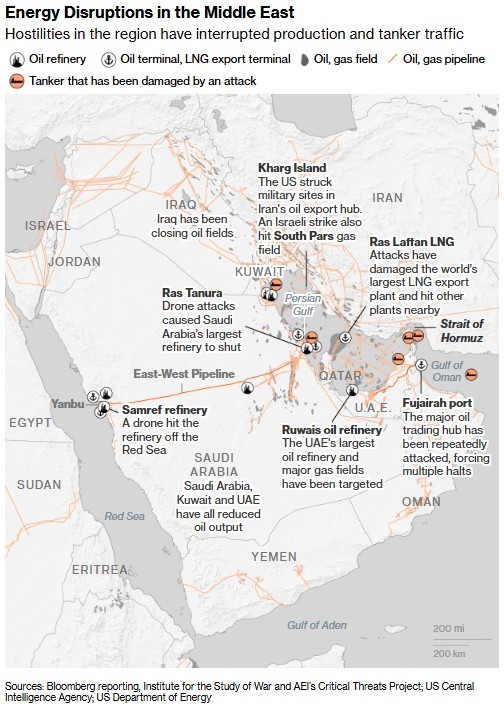
Missile and drone strikes have damaged dozens of key Gulf facilities. While full damage assessments remain fluid, confirmed and widely reported impacts include:
Kuwait oil refinery (fire reported after direct strike)
Abu Dhabi gas project (caught fire)
Ruwais refinery and related facilities in the UAE
Ras Tanura complex in Saudi Arabia
Bapco refinery in Bahrain
Ras Laffan LNG facilities in Qatar
Oil terminals and storage in Fujairah (UAE) and Yanbu (Saudi Arabia)
Multiple gas fields and ports across the region
Iran has tightened control over the Strait of Hormuz, the chokepoint for roughly 20% of global seaborne oil. Even partial restrictions or insurance-driven shipping halts have created immediate physical tightness.
These are not minor hits. Refineries, export terminals, and LNG plants represent both crude supply and product output. The market is pricing in months of lost barrels, not days.
Ukraine-Russia War: Four Months of Relentless Energy Asset Strikes
The Russia-Ukraine conflict has quietly added another layer of global supply pressure. Since December 2025, Ukraine has dramatically escalated long-range drone campaigns targeting Russian oil infrastructure:
March 2026 alone: At least 10 major oil refining and export facilities struck, including Kirishi (Leningrad Oblast — one of Russia’s largest; key distillation units damaged and processing halted), Saratov (Rosneft — crude distillation unit shut), Yaroslavl, and multiple export terminals such as Ust-Luga on the Baltic.
Earlier in the window (Feb 2026): Volgograd (Lukoil) completely shut after strikes on primary processing units; Ilsky refinery fire.
Cumulative impact: Over 100 strikes on Russian refining since early 2025, with 2025 processing volumes already down 1.7% to a 15-year low. Direct damages exceed $12 billion, and export flows have been repeatedly disrupted.
Russia has responded with its own barrage on Ukrainian power plants, substations, and gas infrastructure, but the net global effect is reduced Russian product exports and tighter refined-fuel markets. When you layer this on top of Gulf losses, the supply-side shock is historic.
Asian Markets Open in Hours — What to Watch Tonight/Tomorrow
Asian trading sessions (Tokyo, Singapore, Shanghai) will set the tone before London and New York open. As of late Sunday evening
UTC: Brent futures closed the week near $109–$112/bbl (after a multi-week surge of 36–47% since the Iran conflict began).
WTI has similarly been in the low-to-mid $110s in recent sessions.
Physical (delivery) prices are dramatically higher: Dated Brent spot hit $141.36 (highest since 2008), Dubai physical crude trading $126–$140/bbl — a $37–$40 premium over paper benchmarks.
Oman crude has traded in the high $160s.
This is the widest paper-vs-physical divergence in modern crude history. It reflects real barrels being scarce while futures traders still hope for a quick diplomatic breakthrough.
Paper vs. Delivery Prices: Will Futures Catch Up?
Yes — history and market mechanics say the gap will narrow, and paper prices will likely spike closer to physical levels if the crisis drags on.
Current structure: Extreme backwardation (near-month contracts far above deferred months). This screams “immediate barrels are worth a fortune.”
Why the gap exists: Futures (paper) can be traded electronically with leverage; physical delivery requires actual tankers, insurance, and route viability through or around Hormuz. Traders and refiners are paying huge premiums for real cargoes in Asia right now.
Convergence path: As more physical deals print at $130–$170 levels, arbitrageurs and speculators will bid futures higher to align with reality. We have already seen Brent futures jump from ~$73 pre-war to over $109. Another leg toward $130–$140+ is plausible on bad news. $149 would require fresh escalation (full Hormuz closure or major new refinery loss), but it is no longer unthinkable.
What Investors Should Look For in This Volatile Market
Hormuz status and shipping data — Any confirmed reopening or new attacks will move price 5–10% in minutes.
Physical cargo premiums in Asia — Watch Dubai, Oman, and Murban spot trades; they lead futures.
Futures curve — Watch how fast backwardation flattens or steepens.
OPEC+ and U.S. response — Any coordinated release or production hike announcements.
Inventory reports (EIA, API) — Drawdowns will confirm tightness; builds will cap the rally.
Geopolitical headlines — Ceasefire rumors or Trump administration statements can reverse moves instantly.
Risk management is everything: tight stops, position sizing, and hedging with options are essential.
How Consumers Should Prepare
Retail fuel and heating costs are already climbing and will likely stay elevated for weeks or months. Practical steps:
Fill up early and consider topping off vehicles before further spikes.
Lock in heating oil or propane contracts if you use them.
Shift driving habits — combine trips, carpool, or use public transit where possible.
Review household energy use; small efficiency gains compound at $4–$5/gallon gasoline.
Budget for higher costs — grocery and goods prices will follow transport fuel higher.
Longer term, this reinforces the case for diversified energy sources and efficiency upgrades.
The market is in full “fear premium” mode. $149 on the open tomorrow would be a shock move, but the ingredients (Gulf damage + Russian refining hits + physical/paper disconnect) make a continued violent upside the most likely path until diplomacy or new supply arrives. Trade the volatility, not the hope.
Appendix: Sources and Links
- Bloomberg – “Here’s a List of Gulf Energy Infrastructure Damaged in Iran War” (Mar 25, 2026, updated Apr 3): https://www.bloomberg.com/news/articles/2026-03-25/here-s-a-list-of-gulf-energy-infrastructure-damaged-in-iran-war
- Reuters – Ukraine renews attacks on Russian energy sites (Mar 27, 2026): https://www.reuters.com/business/energy/ukraine-renews-attacks-russian-energy-sites-what-has-been-hit-2026-03-24/
- CNN – Ukraine steps up attacks on Russian oil industry (Mar 28, 2026): https://www.cnn.com/2026/03/28/europe/ukraine-attacks-russia-oil-intl
- Kyiv Independent – Ukrainian drones hammered Kirishi refinery (Mar 27, 2026)
- Investing.com – Brent Crude Oil Futures (real-time April 2026 levels)
- EBC Financial – “Paper Oil vs Physical Oil: The $40 Gap” (Apr 2, 2026)
- Additional reporting from IEA Oil Market Report March 2026, CME Group Brent futures quotes, and S&P Global physical assessments.
Stay tuned to Energy News Beat for live updates as Asian markets open and the new trading week begins. This is one of the most consequential energy shocks in a decade — position accordingly.